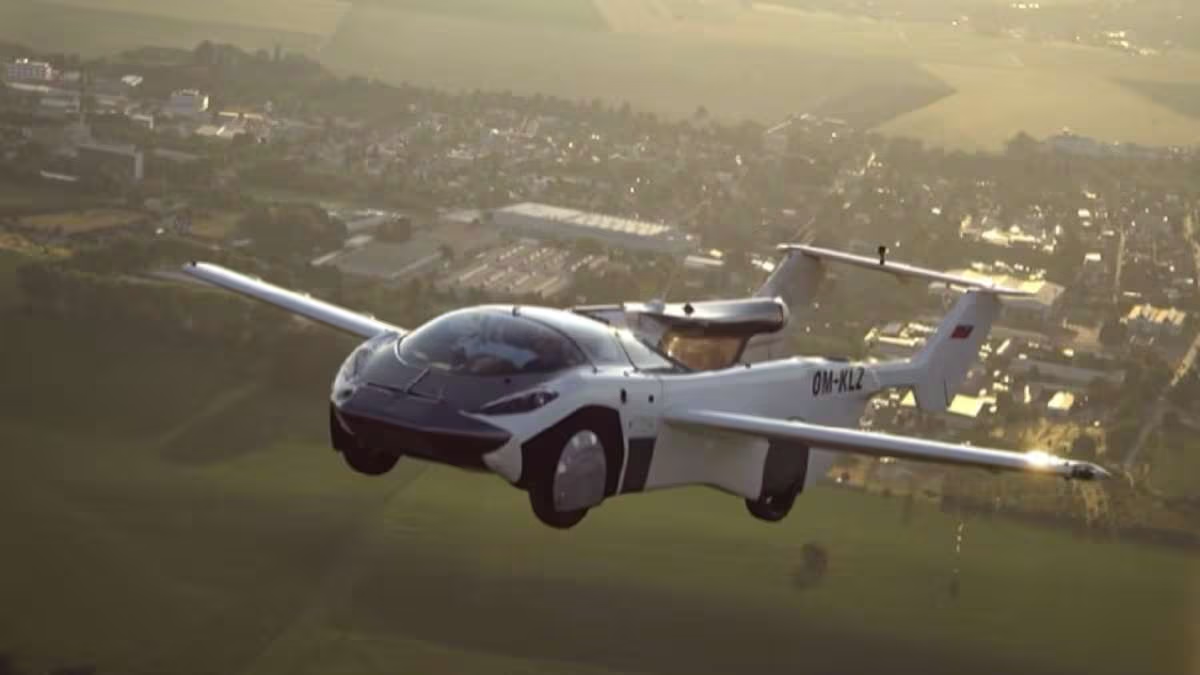
A proposal to introduce air taxis in the Delhi–NCR region has reopened debate on how emerging technologies could reshape urban mobility in one of India’s most congested metropolitan areas. The concept, outlined in a recent industry-backed study, suggests a pilot aerial corridor linking Gurugram, central Delhi and the upcoming international airport at Jewar, with the aim of sharply reducing travel time across critical economic nodes.
The proposal centres on electric vertical take-off and landing aircraft, or eVTOLs, which are designed to operate over short distances without the need for conventional runways. Industry experts argue that Delhi NCR air taxis could bypass surface congestion entirely, offering point-to-point connectivity in a region where peak-hour road journeys often stretch unpredictably beyond planned schedules. Urban mobility specialists note that the suggested route connects three zones with distinct economic roles: Gurugram as a corporate and technology hub, Connaught Place as a central business district, and Jewar as a future aviation and logistics gateway. Faster connectivity between these nodes could improve productivity while easing pressure on arterial roads and expressways already operating near capacity.
The proposal positions air taxis as a complementary layer rather than a replacement for mass transit. In early phases, the technology is expected to serve specialised use cases such as medical logistics, emergency response and time-critical cargo, where minutes can significantly influence outcomes. Public transport planners say such applications allow authorities to test safety, airspace integration and operational protocols before considering broader passenger use. From an infrastructure perspective, the idea raises important questions for city planning. Unlike traditional aviation, eVTOL operations would require smaller landing and charging facilities integrated into dense urban environments. Real estate analysts suggest this could drive demand for rooftop retrofits, transit-oriented developments and mixed-use hubs designed to accommodate new forms of mobility without consuming additional land.
Environmental considerations will also shape the feasibility of Delhi NCR air taxis. While electric propulsion offers lower direct emissions than conventional helicopters, experts caution that lifecycle emissions, energy sourcing and noise management must be carefully assessed. Integrating such systems into a zero-carbon urban transport strategy would require alignment with renewable energy deployment and strict operational standards. Regulatory readiness remains a key variable. Airspace management, safety certification and coordination between civil aviation authorities and city governments will determine how quickly pilot projects can move from concept to execution.
Industry observers note that global cities experimenting with similar technologies are proceeding cautiously, prioritising governance frameworks over rapid rollout.
As Delhi-NCR continues to expand spatially and economically, the pressure on existing transport infrastructure is unlikely to ease. Whether air taxis evolve into a practical mobility solution or remain a niche intervention will depend on cost, scalability and public acceptance. What is clear is that the proposal signals a growing willingness to explore unconventional tools to address long-standing urban mobility challenges.
Delhi NCR Air Taxis Proposed For Faster Commutes