


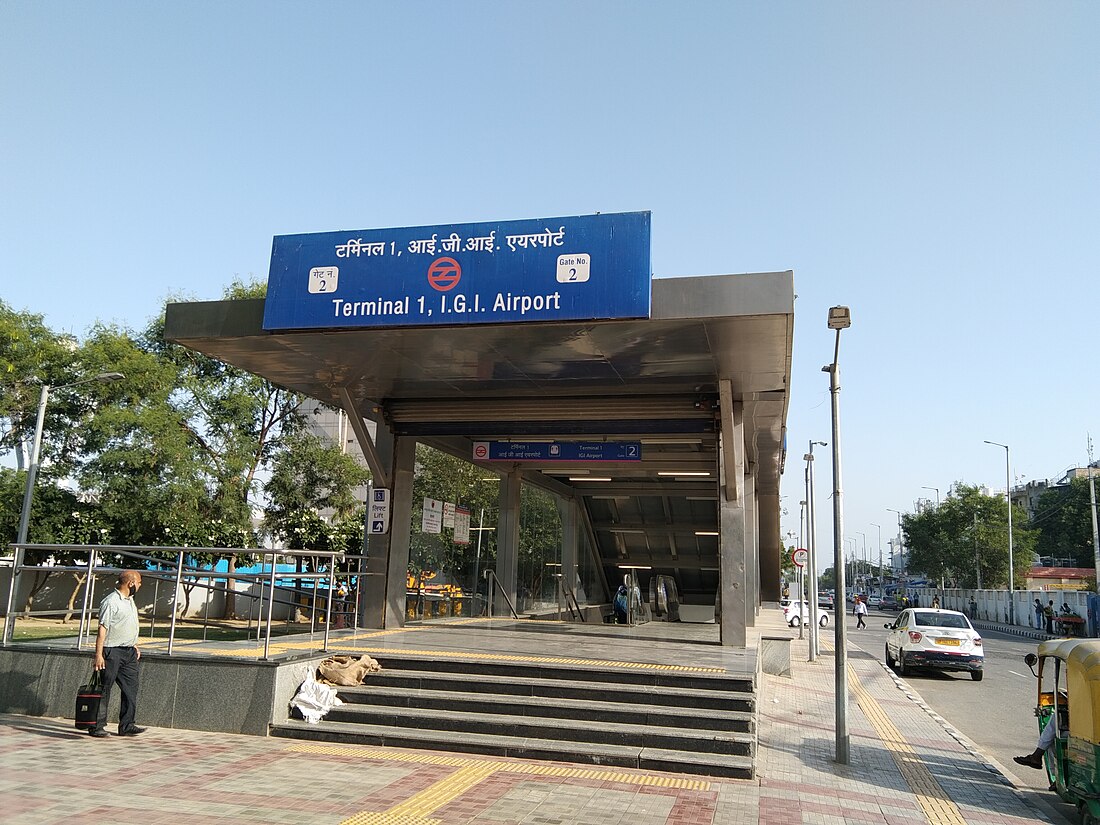
Delhi is set to witness a major boost in its public transport connectivity as the long-pending metro link between Indira Gandhi International Airport’s Terminal 1 (T1) and Terminal 3 (T3) edges closer to reality. The plan, which has cleared key approvals at the city level, is expected to significantly cut travel time between the domestic and international terminals. The proposed link will be built as part of the Golden Line metro corridor, with operations targeted for completion by 2027.
At present, T3 is served by the Airport Express Line, while T1 is linked to the Magenta Line, but the two remain disconnected. Passengers rely on shuttle buses, cabs or private vehicles to make inter-terminal transfers, a system often criticised for being slow, unreliable and carbon-intensive. With the Golden Line extension, a passenger arriving at T3 will be able to board the Airport Express, alight at Aerocity, and transfer to the Golden Line to reach T1 in about ten minutes — a move expected to transform the airport transfer experience. Officials familiar with the development confirmed that the Detailed Project Report (DPR) for the extension has been finalised and received approval from the Delhi government. The plan now awaits clearance from the Union Cabinet, following review by the Ministry of Housing and Urban Affairs. Once the nod is secured, construction work is expected to commence swiftly, aligning with the government’s broader aim of positioning Delhi as an international aviation hub.
Aviation experts point out that while Delhi Airport has been recording steady growth in connecting traffic, the absence of seamless inter-terminal connectivity has long remained a bottleneck. At present, about 21 percent of the airport’s traffic is transit-based, and authorities aim to increase the international-to-international share from the current 3 percent to nearly 10 percent in the coming years. Improved metro connectivity is being viewed as a critical enabler of this growth, not only by easing movement but also by promoting sustainable urban mobility. Officials highlighted that the expansion complements Delhi’s long-term mobility vision of reducing reliance on road-based transfers. Currently, the inter-terminal commute largely depends on shuttle buses and app-based taxis, contributing to both congestion and emissions. A dedicated metro link, in contrast, offers a cleaner and faster option in line with India’s climate commitments and the push towards zero-carbon cities.
While plans for a fully automated intra-airport people mover remain under evaluation, the metro extension is seen as the most practical and time-bound solution for passenger convenience. Industry observers believe the project will not only improve passenger experience but also make Delhi more competitive as an aviation hub in the Asia-Pacific region. If executed as planned, by 2027, the Golden Line will bridge the gap between Delhi’s busiest airport terminals, delivering both operational efficiency and a greener mobility alternative for millions of passengers.
Also Read : PM to inaugurate Bengal metro and launch Bihar poll campaign during visit today
