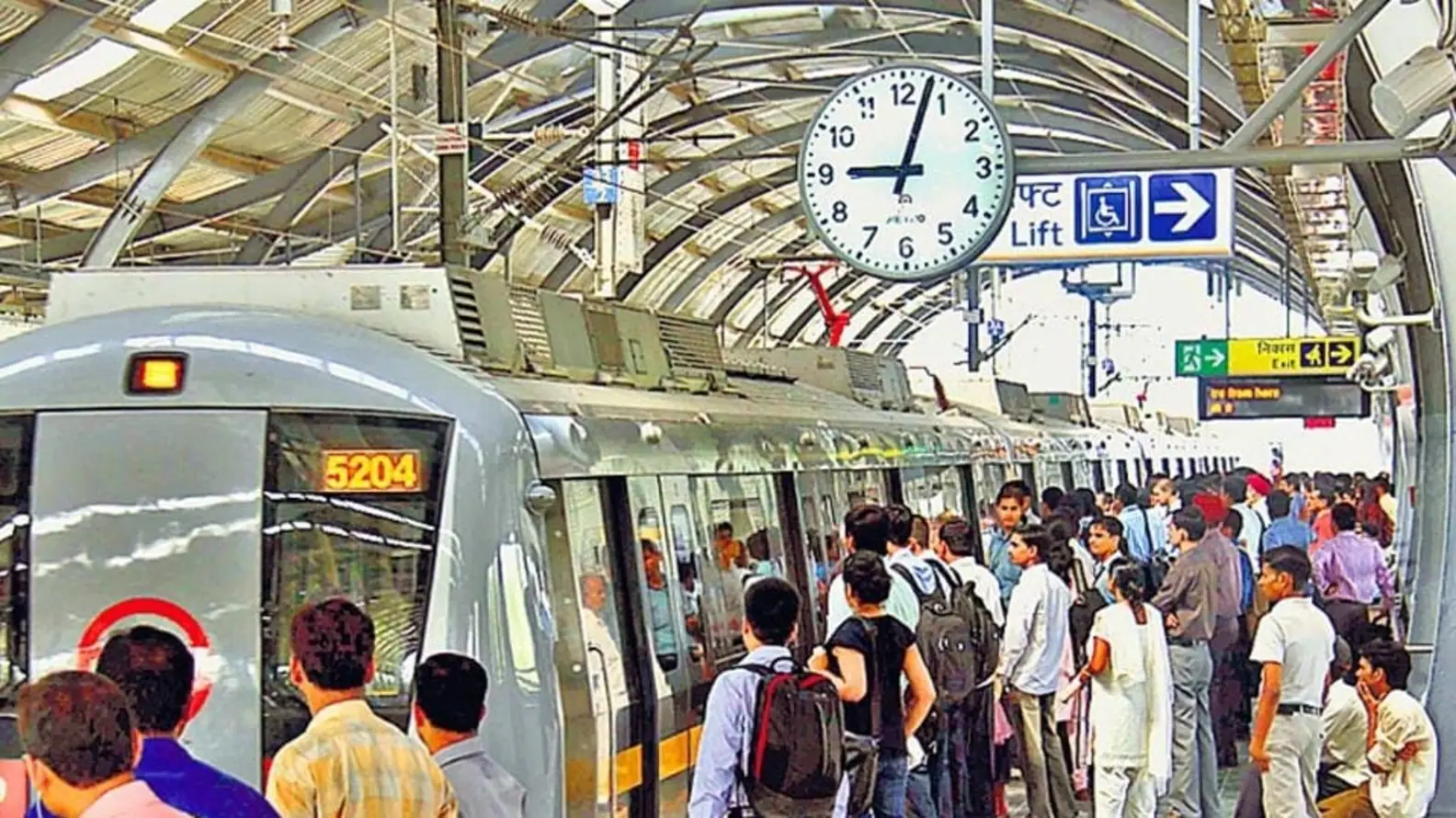
Public transport demand in the National Capital Region continues to strengthen as Delhi Metro passenger journeys reached approximately 235.8 crore in 2025, marking a steady rise in commuter reliance on the city’s rail-based transit system. Transport officials say the increase reflects both network expansion and a sustained shift towards high-capacity urban mobility solutions as Delhi navigates population growth, congestion and environmental pressures. Operational data released by the metro authority indicates that the system carried an average of about 64.6 lakh passengers each day during the year. This represents a noticeable increase compared with the previous year, when daily ridership averaged slightly over 62 lakh journeys. The upward trend suggests that metro travel has become increasingly central to daily commuting patterns across the capital and surrounding NCR cities.
Urban mobility experts say the surge in Delhi Metro passenger journeys underscores the system’s evolving role as a regional transit backbone connecting residential neighbourhoods, employment centres and satellite cities. With the Delhi–NCR metropolitan region expanding rapidly, rail-based transport is emerging as one of the few scalable solutions capable of handling large passenger volumes while reducing dependence on private vehicles. Recent additions to the metro network have contributed to the rise in ridership. Newly operational stretches on key corridors have strengthened connectivity in several parts of the city, helping close network gaps and improve travel options for commuters moving between densely populated urban districts. The Delhi–NCR metro system now spans more than 400 kilometres of operational lines with hundreds of stations distributed across the region. This network includes integrated metro corridors linking Delhi with neighbouring urban centres such as Noida, Greater Noida and Gurugram, enabling cross-city commuting across multiple economic zones within the wider metropolitan area.
Transport authorities say the system currently operates hundreds of trainsets running thousands of services every day. These services collectively cover more than one lakh train kilometres daily, providing frequent connectivity across the network while maintaining high operational reliability. Automation has also become a defining feature of the network’s technological evolution. Large sections of two major corridors now operate under unattended train operation systems, where train movement is managed through centralised control systems rather than onboard drivers. Urban transit specialists say this technology enhances safety monitoring, improves service consistency and allows operators to increase service frequency during peak demand. From a sustainability perspective, the continued rise in Delhi Metro passenger journeys carries broader implications for climate-conscious urban development. Rail-based public transport significantly reduces carbon emissions compared with road-based mobility, particularly in megacities where traffic congestion contributes heavily to air pollution. Urban planners note that metro corridors are also shaping real estate development patterns, encouraging transit-oriented growth around station areas and supporting denser, more accessible urban neighbourhoods.
With new corridors under construction and additional trainsets being inducted into the fleet, transport analysts expect metro usage to continue growing. Maintaining this momentum, however, will depend on strengthening last-mile connectivity, improving multimodal integration and ensuring that future network expansion keeps pace with Delhi’s rapidly evolving urban landscape.