


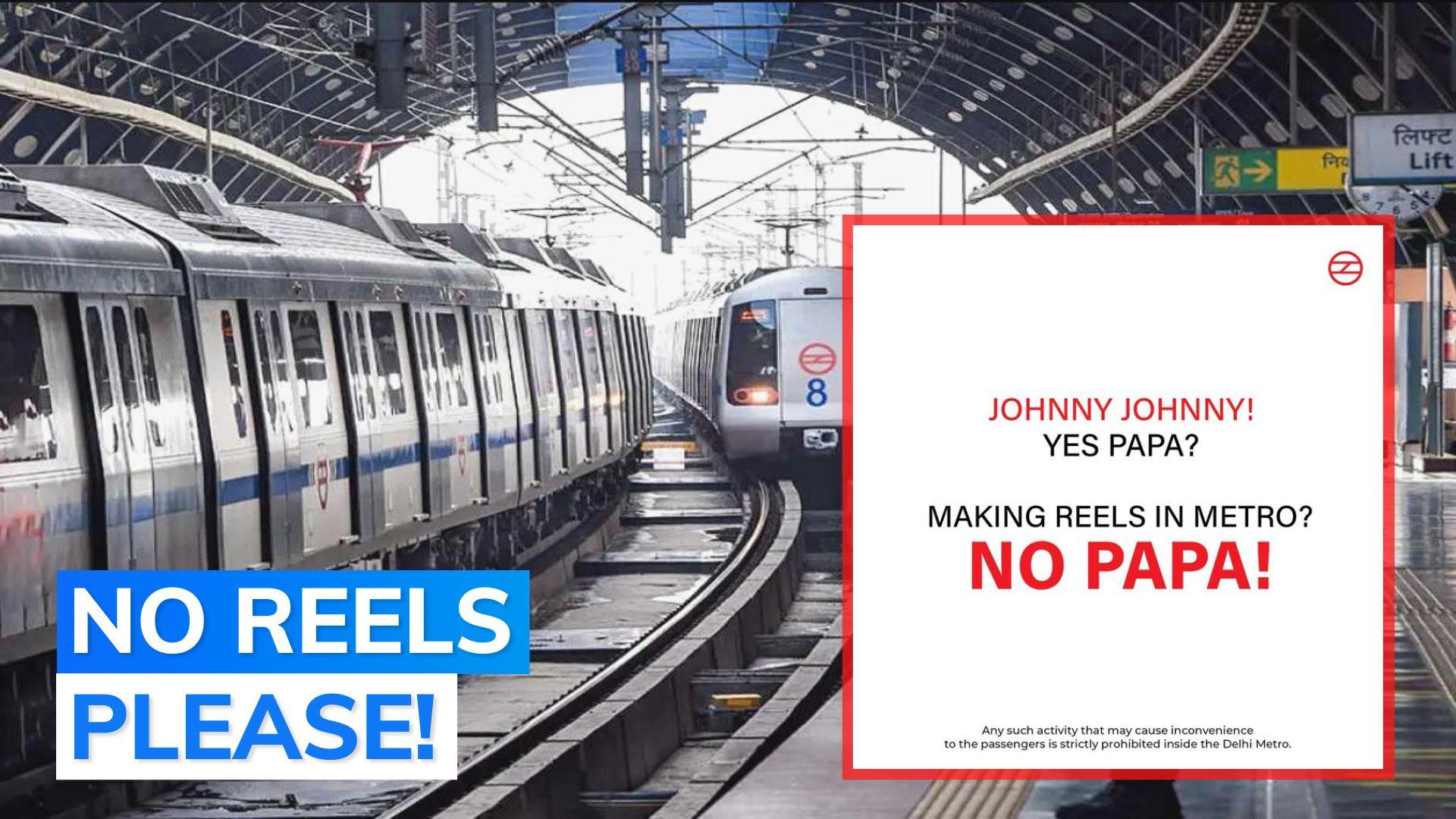
Delhi Metro has issued a fresh appeal urging passengers to refrain from making social media reels inside train coaches and station premises, citing both safety risks and inconvenience to other commuters. Released as part of an awareness initiative on World Social Media Day, the Delhi Metro Rail Corporation (DMRC) campaign titled “Safar Karo, Shoot Nahi” underscores the increasing concern around inappropriate digital content creation in public transport systems.
The advisory comes at a time when metro ridership in Delhi is steadily increasing and authorities are under pressure to ensure commuter comfort and security. DMRC officials emphasised that the growing trend of filming within operational areas often leads to disruptions in smooth movement, compromises passenger safety, and at times breaches metro operational guidelines. The warning was disseminated across official platforms with a reminder that such activities may attract penalties under metro conduct rules. The Delhi Metro, with over 2.8 million daily users, has long been regarded as a symbol of efficient urban mobility. However, the proliferation of smartphones and social media has brought a new wave of behavioural challenges. Officials stated that unauthorised photography or video shoots can distract both passengers and staff, hinder the free flow of movement on platforms and escalators, and sometimes cause avoidable delays during peak hours.
Transport planners have increasingly voiced concern over how infrastructure, originally designed for high-speed transit, is being repurposed by a section of commuters as a backdrop for digital content. While the DMRC clarified that photography for personal memories is not prohibited in most public areas, the trend of elaborate reel shoots with lighting equipment, tripods, or choreographed routines poses significant safety hazards.This advisory is not an isolated one. Metro operators in other Indian cities like Bengaluru and Hyderabad have also issued similar appeals in recent months as social media content creation continues to clash with the functional purpose of urban transit. Internationally, transit systems in Singapore, London, and New York have grappled with similar dilemmas, striking a delicate balance between freedom of expression and civic discipline.
The advisory coincides with DMRC reaching a key milestone in infrastructure development. The metro operator completed a major tunnelling operation on the Tughlakabad-Aerocity corridor of the Phase 4 expansion. Using Earth Pressure Balancing Method (EPBM) technology, a 1,550-metre-long tunnel was successfully constructed between Kishangarh and Vasant Kunj stations. This tunnel lies at an average depth of 22.86 metres, with over 1,100 tunnel rings installed for structural support. This development is part of a broader push under Phase 4, which will add over 40 kilometres of new underground metro infrastructure in the capital. Specifically, the Tughlakabad-Aerocity corridor will include nearly 20 kilometres of underground sections, designed to serve Delhi’s rapidly urbanising southern and southwestern stretches.
Metro engineers involved in the tunnelling operation pointed out that the construction was executed using advanced precast concrete segments cured via mechanised steam curing systems to ensure early strength and durability. The rings used in the tunnel construction were produced at a dedicated casting yard in Mundka, streamlining logistics and quality assurance. Urban mobility experts have noted that while the DMRC is investing in world-class infrastructure, commuter discipline remains central to sustaining the quality and safety of services. Social media behaviour in transit spaces has emerged as a critical area of concern, where policy enforcement and public education must go hand-in-hand.
Experts argue that public transit systems should not only be viewed as movement corridors but also as shared civic spaces that require respectful conduct. The DMRC’s approach reflects a growing consensus that sustainable transport infrastructure should be safeguarded from non-essential disruptions, including social media practices that may not align with public safety norms. As cities like Delhi push toward more equitable and eco-friendly transit networks, the cultural adaptation of users is as vital as physical infrastructure upgrades. DMRC’s latest campaign is therefore not just about reels or rules but about reinforcing public ownership of common urban assets.
Authorities hinted that future guidelines may include designated zones for photography within large interchange stations, coupled with clearer do’s and don’ts for passengers. However, the overarching message remains one of balance: to travel mindfully, without compromising the experience or safety of fellow commuters. The incident serves as a broader reflection of how modern urban spaces are being shaped not just by engineering and policy but by behavioural shifts in the digital age. It underscores the need for continued civic engagement and the importance of maintaining functional sanctity in shared public spaces like metro systems.
Also Read : Mumbai Metro 3 adds retail zones at BKC and CSMIA T2 stations
