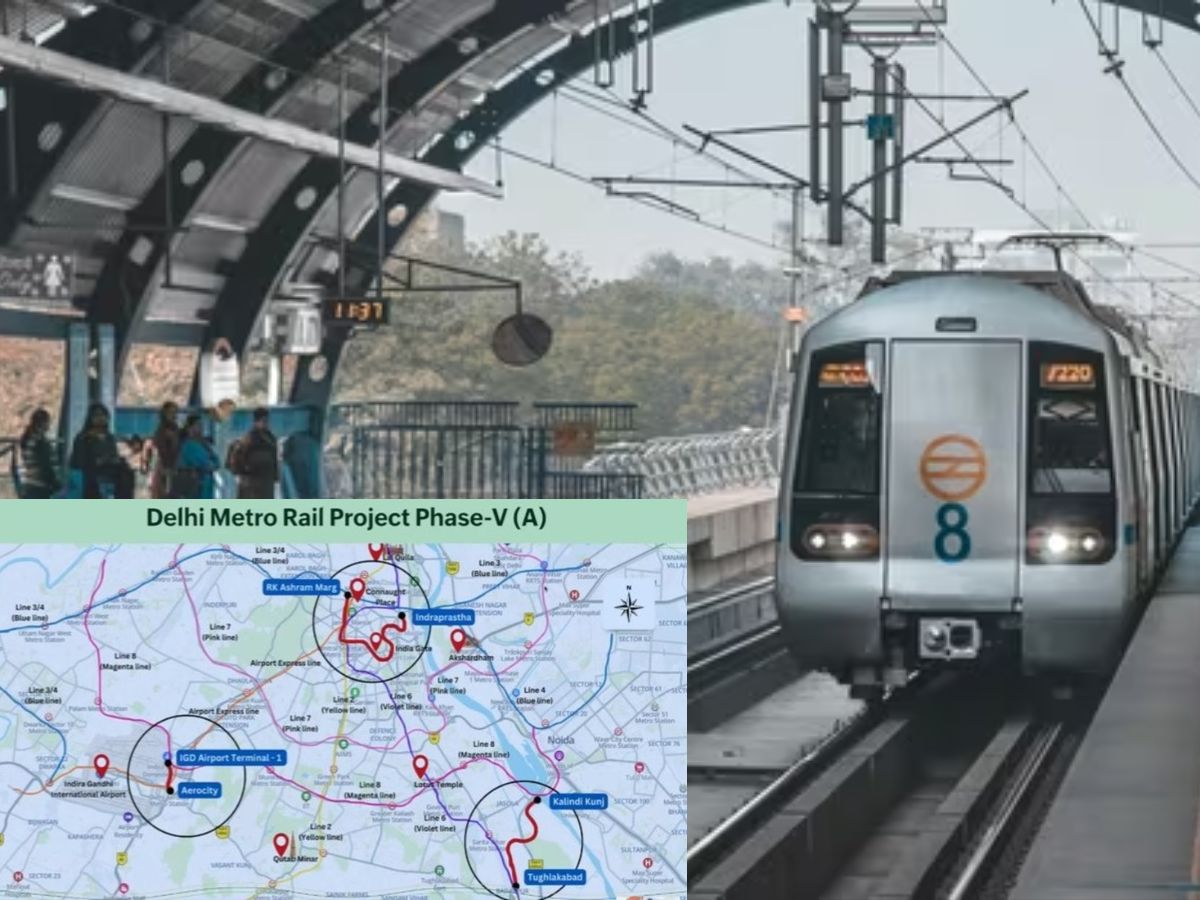
The Union Cabinet has approved the Delhi Metro Phase 5A project, paving the way for a 16-kilometre corridor featuring 13 new stations to be developed over the next three years at an estimated cost of ₹12,015 crore. Once completed, this expansion will push the operational network length of Delhi Metro past the 400-kilometre mark, further strengthening connectivity across high-density residential, commercial, and transit zones.
The Phase 5A initiative encompasses three distinct corridors. The primary stretch, spanning 9.9 kilometres from Ramakrishna Ashram Marg to Indraprastha, is allocated ₹9,570.4 crore. A second 2.3-kilometre elevated corridor will link Aerocity with IGI Airport Terminal-1 at a projected ₹1,419.6 crore. The third segment connects Tughlakabad to Kalindi Kunj over 3.9 kilometres, with an investment of ₹1,024.8 crore. Of the 13 stations, 10 will be underground, addressing urban density constraints, while three will be elevated to optimise construction efficiency and accessibility. Industry experts note that the expansion is strategically positioned to ease severe congestion on arterial city routes and provide enhanced last-mile connectivity. “Phase 5A targets areas with consistently high commuter volumes, reflecting a focused approach to sustainable urban mobility,” an official associated with Delhi Metro Rail Corporation (DMRC) said.
Alongside Phase 5A, construction has begun on the Saket G Block–Lajpat Nagar stretch of Phase 4, which includes an elevated Golden Line (Line-11) branching off from the IGI Airport–Tughlakabad corridor. The 8-kilometre line, featuring eight elevated stations, aims for completion by 2029. The stretch, linking commercial and residential hubs such as Lajpat Nagar, Greater Kailash, and Saket District Centre, is expected to alleviate traffic pressures in the southern suburbs while providing efficient public transport alternatives. The expansions reflect the government’s commitment to sustainable urban mobility, reducing reliance on private vehicles and mitigating carbon emissions. An urban transport analyst remarked, “These corridors integrate environmental considerations with commuter convenience, aligning with Delhi’s broader net-zero objectives and equitable city planning principles.”
As Delhi Metro continues to grow, the network not only strengthens public transport infrastructure but also supports transit-oriented development, promoting compact, connected, and sustainable neighbourhoods. Residents and businesses along these corridors can expect improved access to employment, commercial services, and airports, while the city benefits from decreased road congestion and lower transport-related emissions.
Delhi Metro Expansion Approved With 13 New Stations Over Three Years