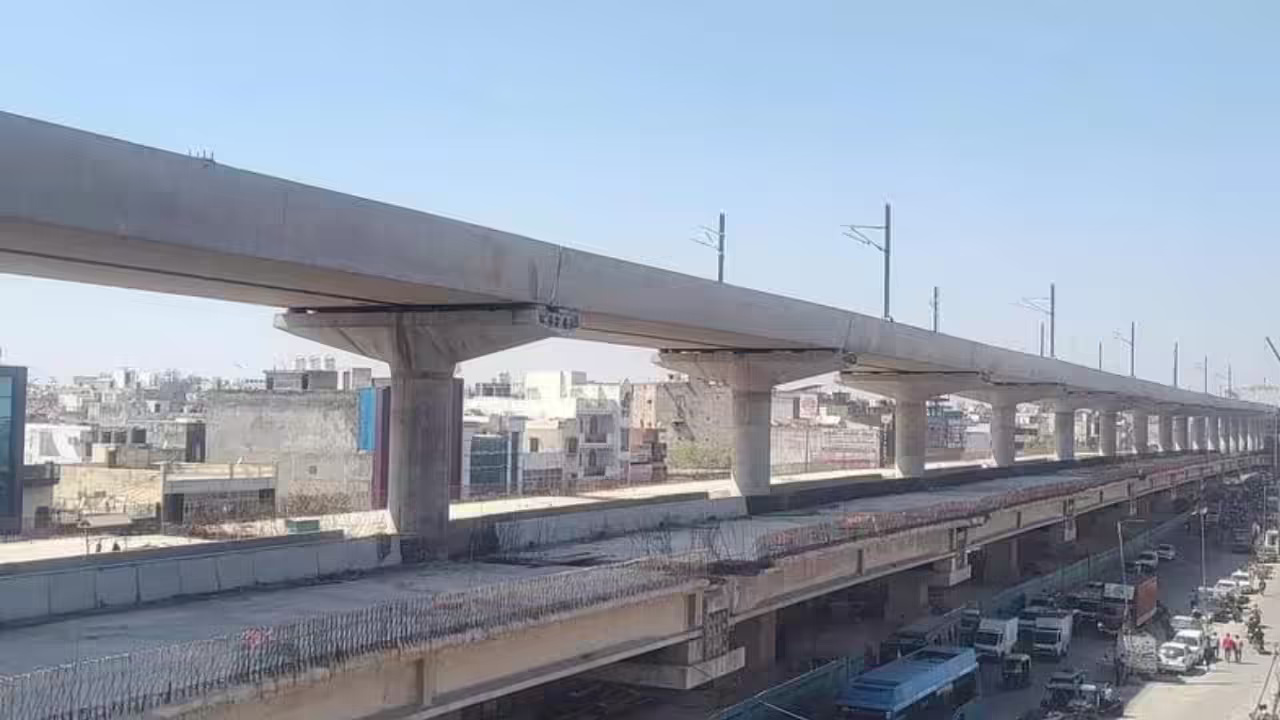
Work on the capital’s first integrated road-and-metro double decker flyover is set to move forward again after a prolonged pause, marking a renewed push to optimise limited urban space while addressing congestion in northeast Delhi. Transport planners say the project represents a significant experiment in stacking infrastructure to improve mobility without expanding road corridors in densely built neighbourhoods. The structure, located along the corridor connecting Bhajanpura and Yamuna Vihar, combines two layers of transport infrastructure within a single footprint. The lower deck functions as a road flyover designed to ease traffic flow along a busy arterial route, while an elevated metro viaduct operates directly above it as part of the city’s expanding rapid transit network.
Although the metro section above the corridor has already begun operations, the road component has remained unfinished due to construction delays and regulatory clearances required for the alignment. Transport authorities have now initiated fresh procurement processes to complete the remaining engineering work required to make the double decker flyover fully operational. Officials familiar with the project said the new contract will cover pending structural works including the construction of approach ramps and reinforcement of earth-retaining systems that support the flyover’s elevated roadway. Once the contractor is finalised, the remaining work is expected to proceed on an accelerated timeline. Urban planners view the project as a strategic response to the capital’s growing mobility challenges. Northeast Delhi, one of the city’s most densely populated regions, faces persistent traffic bottlenecks due to narrow road corridors and rapid population growth. By stacking transport infrastructure vertically, authorities aim to create additional mobility capacity without requiring large-scale land acquisition.
The concept of a double decker flyover also reflects a broader shift in urban infrastructure planning across Indian cities. With land becoming increasingly scarce and expensive, transport agencies are exploring multi-layered transport solutions that combine roads, metro lines, and pedestrian infrastructure within compact corridors. Infrastructure experts say the model offers multiple advantages. In addition to reducing land use, integrated corridors can improve travel efficiency by connecting public transport systems with road networks at strategic points. This approach can also encourage commuters to shift from private vehicles to mass transit, which in turn helps lower traffic congestion and emissions. The Bhajanpura–Yamuna Vihar corridor forms part of the metro system’s ongoing expansion programme, which includes several new routes and extensions aimed at strengthening connectivity across the National Capital Region. Similar multi-level transport structures are also under construction in other parts of the metro network as part of future expansion phases.
Urban mobility specialists believe such infrastructure experiments will play an increasingly important role in shaping the capital’s transport landscape. If completed as planned, the double decker flyover could serve as a template for future integrated transport corridors designed to manage congestion while supporting more sustainable urban mobility.