


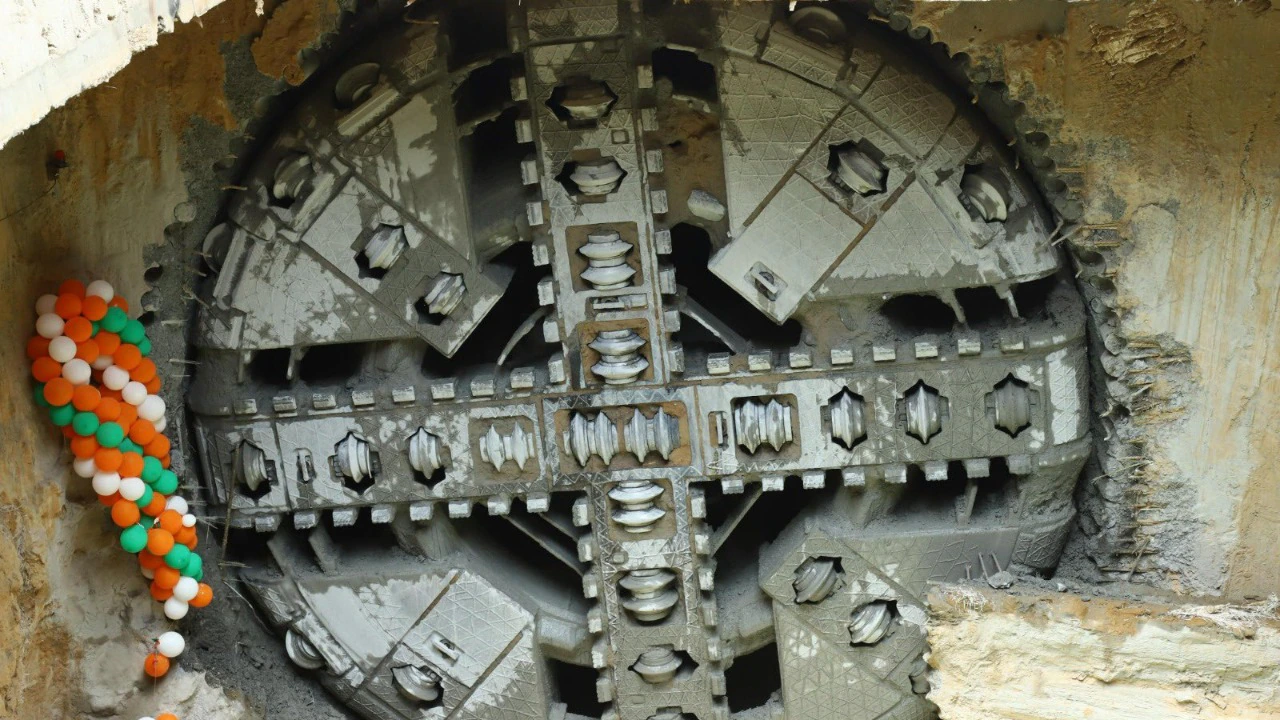
To boost Delhi’s metro infrastructure, a tunnel boring machine (TBM) has successfully completed a 792-metre underground stretch on the Golden Line corridor, part of the city’s Phase IV expansion. The breakthrough marks a key moment in the 23.6-km corridor’s progress, which includes 19.3 km of underground tracks connecting 15 stations across densely populated urban pockets.
This tunnel, excavated using a 91-metre-long TBM, is designed to facilitate both up and down train movement. Constructed at an average depth of 18 metres, the tunnel comprises 559 precast concrete rings — each with a 5.8-metre internal diameter — manufactured at a mechanised casting yard in Mundka and cured using steam to accelerate strength development. Officials overseeing the project confirmed that the tunnel was developed using the Earth Pressure Balancing (EPB) method — a globally recognised tunnelling technique known for reducing ground settlement in congested urban areas. This method plays a crucial role in minimising disruption at the surface level and ensuring safety in adjacent built environments.
In alignment with sustainability-focused construction practices, the Delhi Metro Rail Corporation (DMRC) deployed highly sensitive instruments to monitor ground movement during the tunnelling process. Experts confirmed that there was no reported settlement of nearby structures, validating the effectiveness of the real-time monitoring systems in place. The emphasis on minimising environmental disruption and ensuring community safety aligns with DMRC’s broader commitment to building an equitable and eco-friendly urban transit system. The Golden Line corridor, once completed, will significantly enhance intra-city connectivity and is expected to serve as a critical backbone for East-West movement across the national capital. The new line is part of a larger 40.1-km underground network currently under development in Phase IV, which aims to expand the city’s mass rapid transit coverage while adhering to global standards of safety, sustainability, and commuter experience.
Since its early phases, DMRC has leaned heavily on TBM technology to navigate the challenges of Delhi’s complex underground terrain. Phase III alone saw nearly 50 km of tunnelling executed with 30 TBMs, enabling faster implementation with minimal disruption to life at the surface. The current tunnelling success underscores not just technical advancement, but also Delhi Metro’s larger ambition to transform urban mobility while aligning with India’s climate commitments and vision of a low-carbon transport future.
As the corridor inches closer to completion, its timely delivery will be vital in easing surface congestion, promoting public transit use, and fostering equitable access to mobility across socio-economic groups. The tunnelling milestone is more than an engineering achievement — it is a step forward for Delhi’s evolving transit future built on sustainable foundations.
Also Read : Mumbai-Ahmedabad Bullet Train Aims 2029 Launch, Construction Work Speeds Up
