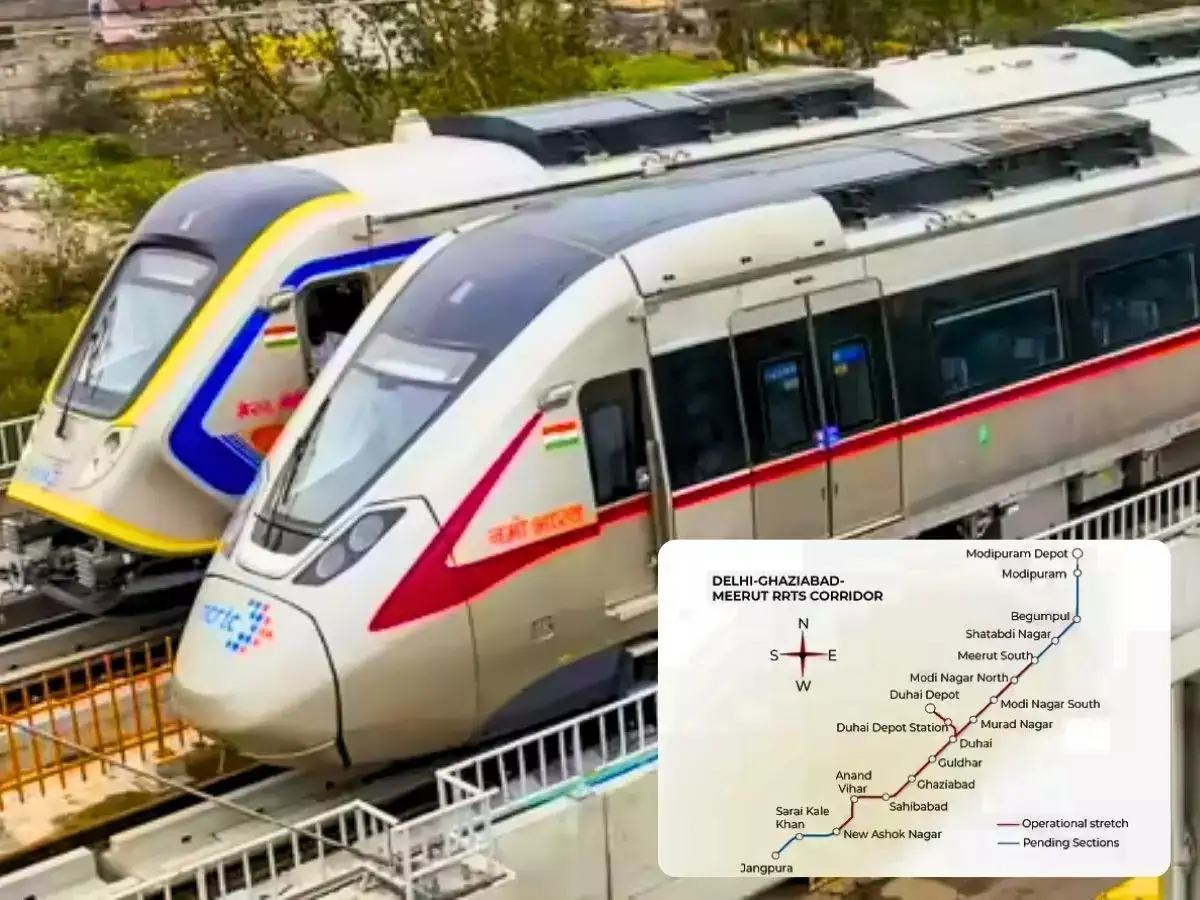
DELHI — The full 82-kilometre Delhi–Meerut Regional Rapid Transit System (RRTS) corridor, operated under the Namo Bharat brand, is now fully operational, reducing travel time between Delhi and Meerut to around 55 minutes — a dramatic transformation for one of India’s most congested commuter corridors.
The inauguration of the complete route represents a major milestone in urban and regional transport infrastructure, with implications for daily mobility, economic integration and sustainable city growth across the National Capital Region. Developed and implemented by the National Capital Region Transport Corporation (NCRTC), the corridor links Sarai Kale Khan in Delhi with Modipuram in Meerut, passing through key urban centres such as Ghaziabad, Sahibabad and Modinagar. Trains on the corridor operate at regular intervals and at speeds of up to 160 km/h, offering a reliable and rapid alternative to road travel, which previously took 2–3 hours depending on traffic conditions. Urban transport specialists note that the RRTS model blends characteristics of metro, suburban rail and high-speed services, with minimal stops and high-frequency operations designed to encourage modal shift from private vehicles and long-haul buses.
Reducing travel time to under an hour is expected to reconfigure commuter patterns, especially for residents in western Uttar Pradesh who work, study or conduct regular business in Delhi’s economic and institutional hubs. The corridor’s full operation also marks the completion of several phases of construction and testing that began years earlier but faced delays due to technical, logistical and planning complexities. Its eventual launch underscores how sustained investment and inter-government coordination can deliver major transport infrastructure projects — a key priority for rapidly urbanising regions in India. Infrastructure analysts highlight that enhanced regional connectivity can expand housing and labour market options, as improved transit reduces the friction of distance. This can ease pressure on housing markets in Delhi while promoting more balanced growth across satellite towns and peri-urban zones.
For cities like Meerut and Ghaziabad, the improved connection feeds into broader urban development strategies aimed at attracting investment, talent and service-based economic activity. Environmental and social benefits are also central to the RRTS narrative. Shifting commuters from road to rail can lower vehicular emissions and reduce congestion on major national highways; a modal shift can contribute to improved air quality and reduced noise pollution in densely populated corridors. Integrated multimodal access points — including connections to metro networks, Indian Railways and bus services — further enhance last-mile connectivity and public transport usage. Commuter reactions have been broadly positive, with people reporting significant time savings and comfort improvements compared to bus or private car travel.
Such experiences underscore how high-capacity transit systems can elevate everyday mobility for a broad cross-section of urban users, from daily commuters to occasional travellers. Looking ahead, planners and policy makers view the operational success of the Delhi–Meerut RRTS corridor as a template for similar rapid transit projects in other metropolitan regions. Proposed corridors such as Delhi–Panipat and Delhi–Alwar aim to further expand the RRTS network, embedding efficient, sustainable transport into India’s urban growth agenda.