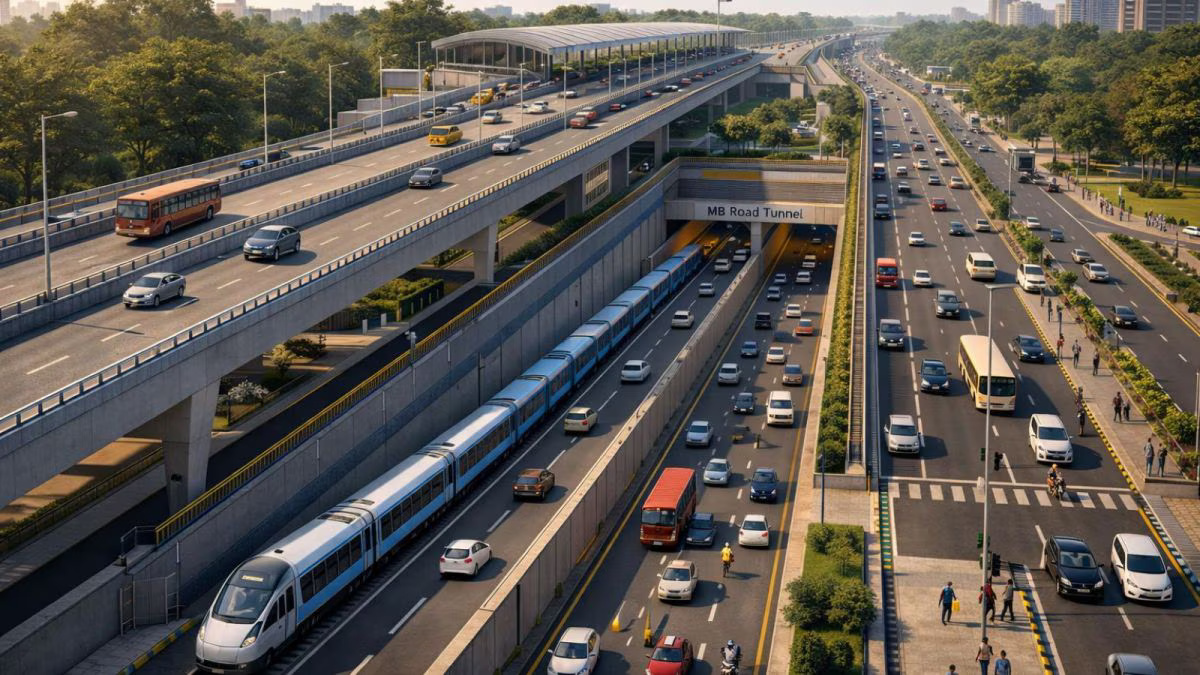
Delhi MB Road Transit Corridor Plan Gains Momentum
A major transport overhaul is being planned for South Delhi, where authorities are preparing a multi-corridor intervention along the Mehrauli–Badarpur stretch to address persistent congestion and mobility bottlenecks. The proposed investment of over Rs 1,400 crore aims to streamline traffic across a key urban artery that connects residential clusters, employment hubs, and inter-city routes linking the National Capital Region. At the center of the plan is the development of an integrated elevated and grade-separated road network forming the MB Road transit corridor, designed to improve traffic flow across nearly 12 kilometers. Officials indicate that the project includes a six-lane elevated structure combined with underpasses in high-density stretches, alongside another elevated link connecting critical junctions further south.
Together, these interventions are expected to reduce travel time, improve safety, and optimize road capacity in one of the capital’s most overburdened corridors. Urban planners note that the Mehrauli–Badarpur route has evolved into a mixed-use spine, where dense residential neighbourhoods coexist with commercial activity, informal markets, and high pedestrian movement. This has led to chronic congestion, especially in areas with unregulated parking, bus halts, and narrow carriageways. The MB Road transit corridor is being positioned as a structural solution to these constraints, rather than a short-term traffic fix. Transport authorities are working in coordination with metro planners, as the proposed road infrastructure aligns with an ongoing phase of rapid transit expansion. This integration is expected to improve multimodal connectivity, particularly at key interchange points, and reduce dependence on private vehicles over time. Experts suggest that such coordination between road and rail systems is essential for building efficient, low-emission urban mobility networks.
Beyond congestion relief, the project has broader economic and environmental implications. Reduced idling time and smoother traffic movement can lower fuel consumption and vehicular emissions, contributing to improved air quality in South Delhi’s dense urban environment. At the same time, enhanced connectivity may unlock real estate value in peripheral neighbourhoods by making them more accessible to employment centers. However, infrastructure specialists caution that elevated corridors alone cannot resolve long-term mobility challenges unless complemented by pedestrian-friendly design, last-mile connectivity, and strict enforcement of parking regulations. Without these, the risk of induced traffic demand could offset initial gains. In parallel, authorities are also evaluating an additional elevated road alignment along the Yamuna floodplain corridor, signaling a broader strategy to decongest inner-city routes by redistributing traffic flows.
As planning agencies move towards preparing detailed project reports, the focus will remain on balancing capacity expansion with sustainability goals. For a rapidly growing metropolis, the success of the MB Road transit corridor will depend not only on engineering execution but also on how well it integrates with a people-centric, climate-conscious urban transport vision.