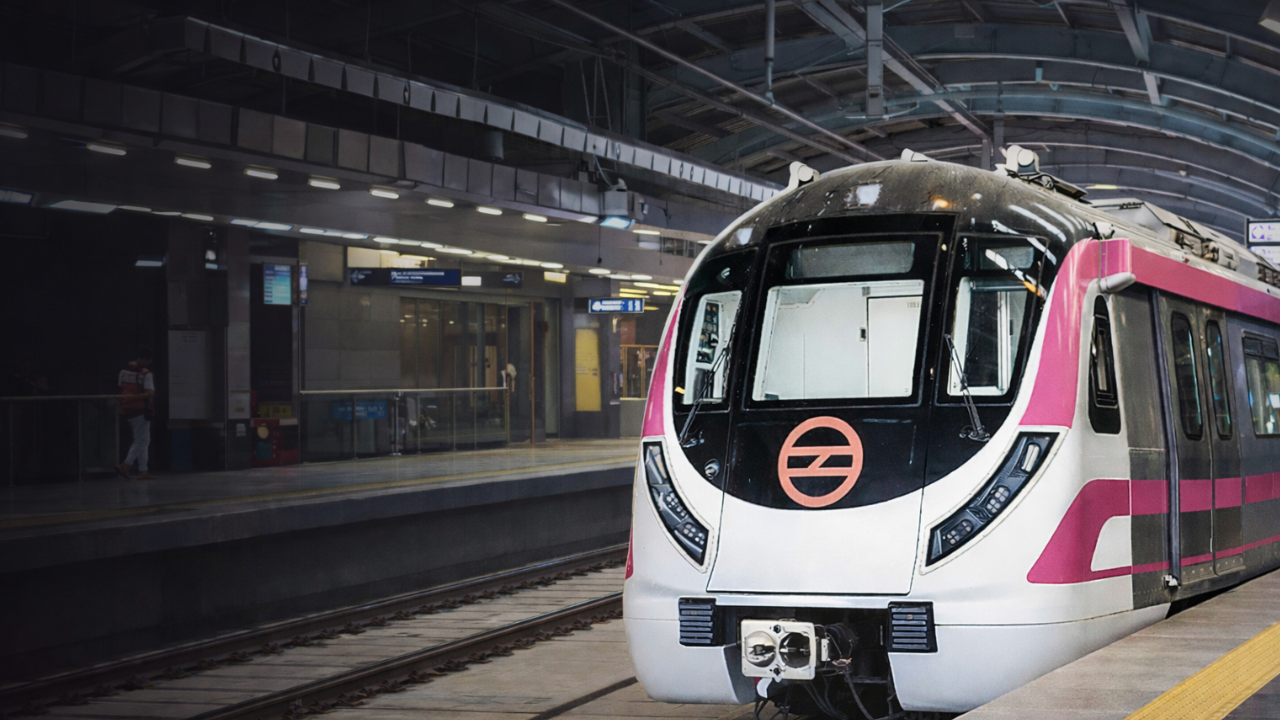
Delhi’s Magenta Line is on course to become the capital’s longest metro corridor, a shift that transport planners say could significantly alter daily movement patterns across the National Capital Region (NCR). Once its planned extension is completed, the corridor will stretch roughly 89 kilometres from Noida’s Botanical Garden to Inderlok in northwest Delhi, consolidating its position as a central east–west mobility spine.
The scale of the corridor is notable not only for its length but also for its integration. With 21 interchange stations planned along the full alignment, the Magenta Line will intersect with multiple existing routes, creating one of the most interconnected segments in the Delhi Metro system. Urban mobility experts note that such dense interchange points reduce dependency on private vehicles by making multi-leg journeys more seamless and predictable. The Magenta Line is also designed to operate entirely without drivers once fully commissioned. Driverless systems, already partially deployed in Delhi, allow for closer train frequency management, improved energy efficiency and lower long-term operational costs. Transport economists argue that automation can help metro systems maintain financial sustainability while accommodating rising passenger volumes in fast-growing metropolitan regions.
Engineering complexity has defined much of the corridor’s development. One station on the line stands as the highest elevated point in the network, with platforms located more than 28 metres above ground level. At the other extreme, another interchange descends nearly 29 metres below the surface, making it the deepest station in the system. Such vertical variation reflects the technical challenges of constructing high-capacity transit infrastructure in a dense urban environment with existing utilities, road corridors and built-up neighbourhoods.
For commuters, the practical impact lies in reduced travel times and simplified transfers between residential hubs, employment clusters and institutional zones. The alignment links key education centres, commercial districts and emerging residential belts across south Delhi, west Delhi and Noida. Real estate consultants say enhanced metro connectivity often triggers higher residential demand near stations, while also encouraging more compact, transit-oriented development.
From an environmental perspective, strengthening the Magenta Line adds capacity to a network already recognised for lowering per-capita transport emissions compared to road travel. As Delhi grapples with chronic air quality concerns, expanded metro corridors are increasingly viewed as core climate infrastructure rather than optional amenities. Each modal shift from car to rail reduces congestion, fuel consumption and roadside pollution. Urban planners suggest the long-term value of the Magenta Line will depend on integration beyond rail including last-mile connectivity, pedestrian access and mixed-use planning around stations. As NCR’s population continues to grow, infrastructure that balances scale with sustainability is likely to shape how inclusive and climate-resilient the region’s next phase of urban expansion becomes.
Delhi Magenta Line Reshapes NCR Mobility