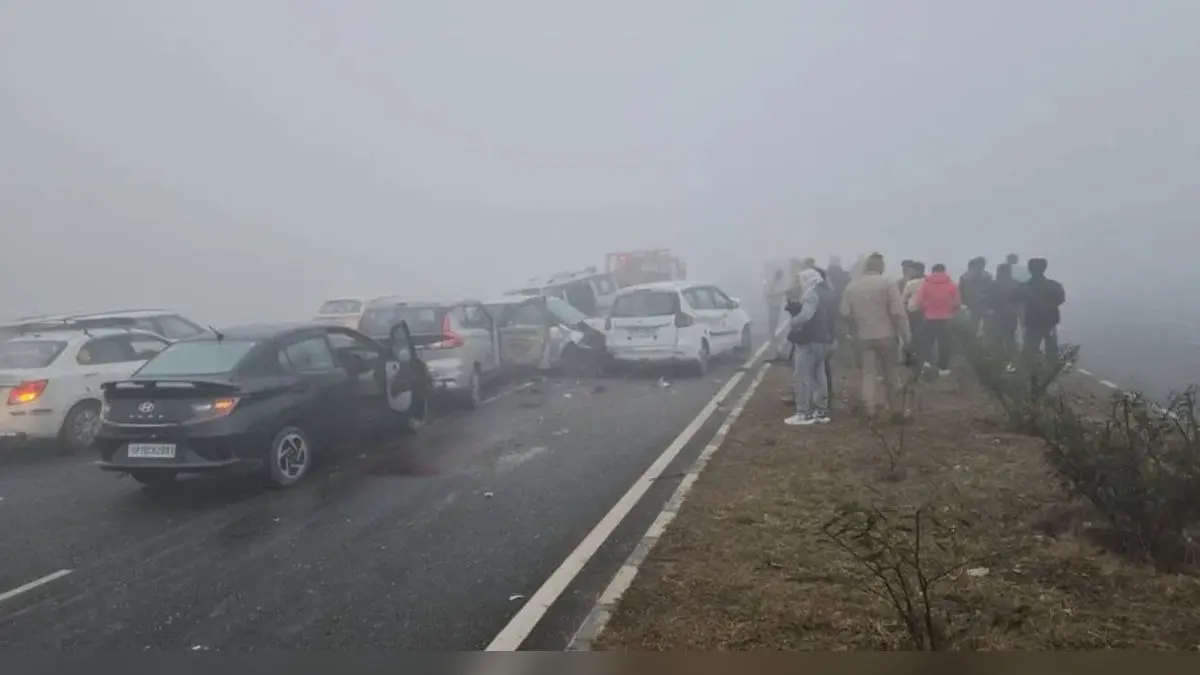
A series of collisions on the Delhi–Lucknow highway in western Uttar Pradesh has once again brought winter road safety into sharp focus, after dense fog triggered multiple vehicle crashes along a key national transport corridor. Beyond the immediate injuries, the incident highlights a wider infrastructure challenge: how climate-linked weather extremes are testing the resilience of India’s expanding highway network and the economic systems that depend on it.
The early-morning crashes occurred on a busy stretch of National Highway-9, a strategic artery connecting the National Capital Region with eastern Uttar Pradesh and beyond. Poor visibility, compounded by inadequate illumination along parts of the roadway, led to successive impacts involving passenger vehicles and freight carriers. Emergency services responded swiftly, clearing damaged vehicles and restoring traffic flow within hours, but several occupants were hospitalised, some in critical condition. For logistics operators and daily commuters alike, this corridor is not just a road but a lifeline. Industry experts note that NH-9 supports high volumes of agri-produce, manufacturing goods and construction material moving between NCR markets and the eastern hinterland. Even short disruptions ripple through supply chains, delaying deliveries and increasing operating costs in an already volatile winter season.
Urban transport planners point to a structural gap between highway expansion and safety retrofitting. While India has rapidly added lane capacity over the past decade, investments in climate-responsive design such as adaptive lighting, intelligent traffic systems and fog-detection sensors have lagged behind. Dense fog is not a new phenomenon in north India, yet most highways remain reliant on conventional signage and manual enforcement, rather than automated warning and speed control systems. The episode also carries implications for regional development and real estate. Improved connectivity has fuelled warehousing hubs, residential projects and industrial parks along the Delhi–Lucknow axis. However, repeated safety incidents risk eroding investor confidence unless matched by visible improvements in road governance and traveller protection. For developers and logistics firms alike, safety is increasingly a commercial consideration, not merely a regulatory one.
Public agencies are now under pressure to integrate climate resilience into highway management. Transport economists argue that preventive investments including reflective road markers, continuous street lighting, weather-linked speed advisories and real-time visibility alerts cost far less than the economic losses and healthcare burdens arising from major accidents. Such measures also align with broader sustainability goals by reducing congestion-related emissions caused by abrupt traffic halts. At a civic level, the incident reinforces the need for a people-first approach to infrastructure, where road users are treated not as throughput numbers but as citizens whose safety underpins urban productivity.
As Delhi air pollution and winter fog become more frequent companions of the season, the intersection of climate, infrastructure and public safety can no longer be treated as separate policy silos. Looking ahead, the challenge for authorities is clear: ensuring that India’s highways are not only wider and faster, but also smarter and safer. With freight volumes and commuter traffic expected to rise further along the Delhi–Lucknow corridor, embedding resilience into road design and operations will be critical to sustaining both economic momentum and public trust.
Delhi Lucknow highway fog exposes safety gaps