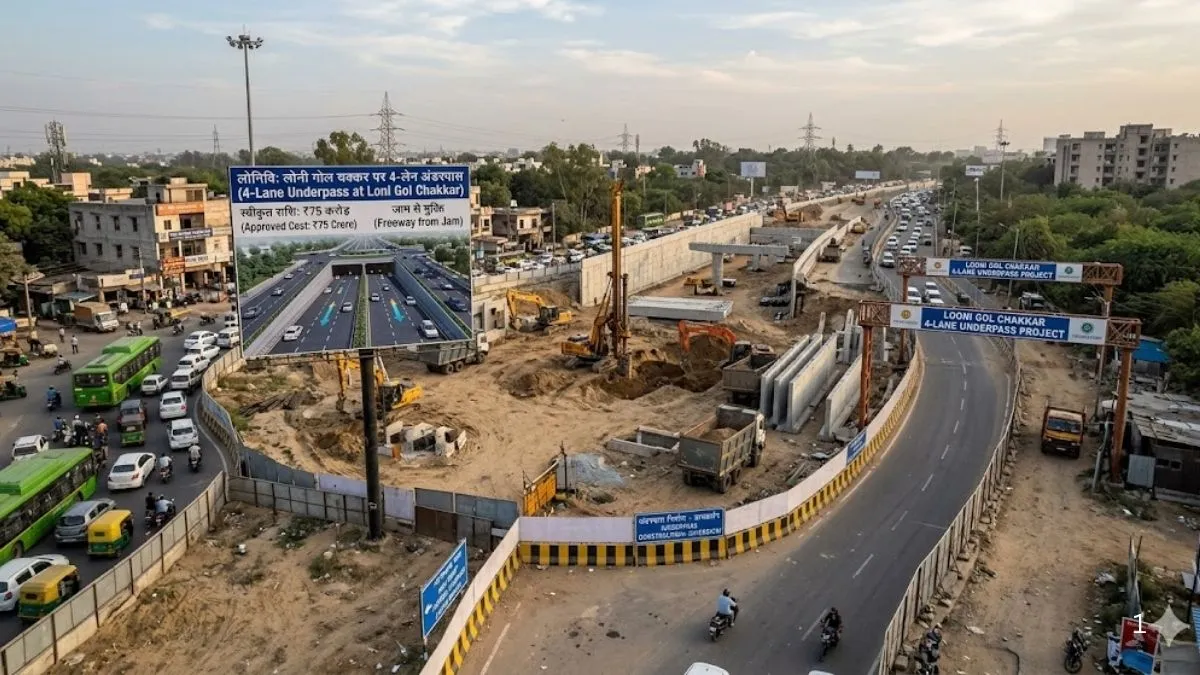
After years of procedural and on-ground delays, construction activity has begun on a key road infrastructure project in northeast Delhi aimed at easing congestion along a heavily trafficked corridor connecting the capital to neighbouring Uttar Pradesh. The Loni underpass project is expected to improve traffic flow on a route that frequently experiences bottlenecks due to high vehicular volumes and signalised intersections. Planned as a grade-separated structure, the underpass is designed to facilitate uninterrupted movement of vehicles along a stretch linking major arterial routes near the city’s eastern edge. Urban transport experts note that such interventions can significantly reduce travel time in high-density corridors, particularly those serving intercity traffic between Delhi and adjoining urban centres.
The Loni underpass project, estimated at around ₹75 crore, has faced multiple hurdles since its initial announcement. Delays were largely attributed to challenges in clearing encroachments, obtaining regulatory approvals for tree removal, and relocating underground utilities such as water pipelines, power lines and telecommunications networks. These issues are common in built-up urban areas, where infrastructure upgrades must navigate existing services and informal settlements. With preliminary clearances now largely in place, authorities are moving towards full-scale execution, with a projected construction timeline of approximately two years. Officials involved in the project indicate that the dense urban setting and continuous traffic movement will require phased construction and careful planning to minimise disruption. From an environmental perspective, the Loni underpass project is expected to contribute to reduced vehicular emissions by cutting idle time at traffic signals. Transport planners emphasise that smoother traffic flow can lead to lower fuel consumption, although long-term benefits depend on integrating such projects with broader strategies to promote public transport and non-motorised mobility.
The project also holds implications for local economic activity and real estate development. Improved connectivity often enhances accessibility to residential and commercial areas, potentially increasing land values and attracting new investments. However, experts caution that infrastructure gains must be balanced with inclusive planning to ensure that benefits are equitably distributed across communities. At a systemic level, the project highlights recurring challenges in urban infrastructure delivery, particularly in rapidly expanding cities. Coordination among multiple agencies, timely clearances and effective stakeholder engagement remain critical to avoiding delays and cost escalations. Urban planners suggest that adopting integrated planning approaches—where road projects are aligned with utilities, environmental considerations and future growth patterns—can improve efficiency. Lessons from delayed projects like this could inform better execution frameworks for upcoming developments.
As construction progresses, the focus will shift to timely delivery and quality control. For commuters navigating one of Delhi’s busiest corridors, the completion of the Loni underpass project could offer tangible relief. More broadly, it reflects the ongoing effort to upgrade urban transport infrastructure in response to rising demand and evolving mobility needs.