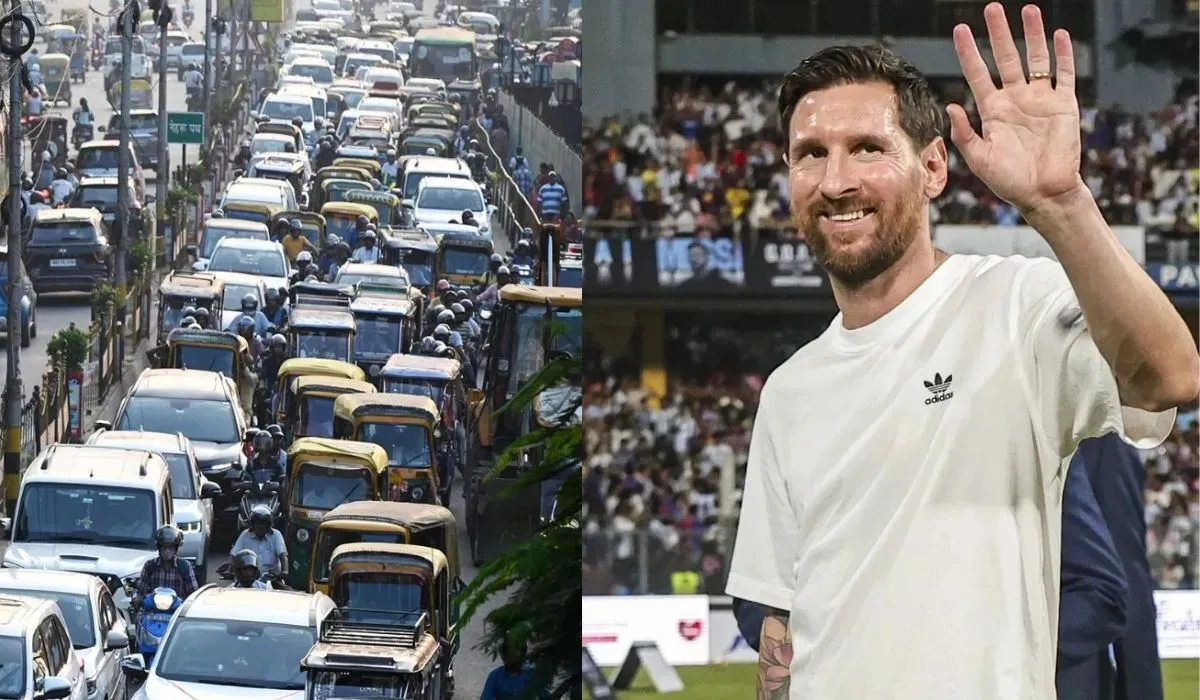
Delhi authorities have issued a detailed traffic advisory ahead of a high-profile sporting appearance at Arun Jaitley Stadium, as the capital prepares to host the final leg of the GOAT India Tour. The event, scheduled between 1 pm and 4 pm, is expected to draw large crowds, prompting temporary traffic restrictions and diversions in central Delhi. The advisory highlights the growing challenge of managing urban mobility during major public events in a densely populated city.
According to the city’s traffic management agency, vehicular movement around the stadium precinct is likely to remain slow due to increased pedestrian activity and security arrangements. Key arterial roads including Bahadurshah Zafar Marg and Jawaharlal Nehru Marg will face partial restrictions, while heavy vehicles will be barred from selected stretches during the event window. Officials said these measures are aimed at ensuring public safety and maintaining emergency access routes. Commuters have been advised to avoid several central corridors between noon and 5 pm. These include Jawaharlal Nehru Marg from Rajghat to Delhi Gate up to Kamla Market, Asaf Ali Road between Turkman Gate and Delhi Gate, and Bahadurshah Zafar Marg from Delhi Gate to the ITO stretch. Traffic personnel will be deployed across intersections to guide motorists and manage congestion in real time.
Urban transport experts note that such advisories reflect the pressure placed on legacy road networks when cities host large-scale cultural and sporting events. While these events contribute to the local economy through tourism, hospitality and retail activity, they also expose gaps in last-mile connectivity, public transport integration and pedestrian infrastructure. “Cities need to plan beyond diversions and think in terms of event-based mobility strategies,” said an urban mobility specialist, pointing to the need for better crowd dispersion and public transport incentives.
The Delhi leg of the GOAT India Tour follows similar events in other metropolitan centres, where large public turnout tested civic preparedness. In Delhi, authorities appear keen to minimise disruption by issuing advance guidance and encouraging commuters to plan alternative routes. Public messaging through official traffic channels has been stepped up to provide real-time updates. From a sustainability perspective, planners argue that cities must increasingly encourage the use of public transport, walking and shared mobility during such events to reduce congestion and emissions.
Temporary road restrictions, when paired with efficient transit options, can support cleaner air and safer streets, aligning with broader goals of inclusive and low-carbon urban development. As Delhi continues to position itself as a global destination for international sporting and cultural events, the effectiveness of such traffic management measures will shape public perception and urban liveability. The success of today’s advisory may offer lessons for how India’s cities can balance economic vibrancy with efficient, people-centric mobility planning.
Delhi Issues Traffic Advisory For Messi GOAT Tour At Arun Jaitley Stadium