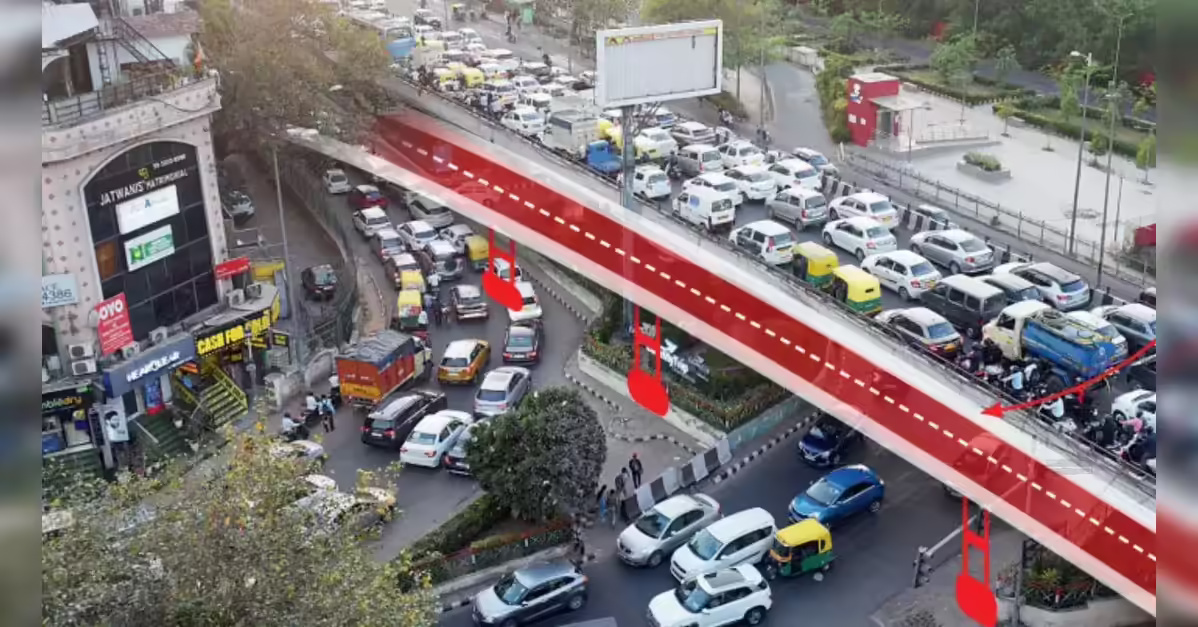
Delhi has announced a significant scale-up in road infrastructure investment, allocating ₹5,921 crore to modernize and expand its arterial network as part of a broader push to address congestion and air pollution. The latest Delhi road infrastructure plan combines large-scale redevelopment, integrated corridors and drainage upgrades, reflecting a shift towards climate-responsive urban mobility systems. A key component of the plan is the resurfacing and redesign of nearly half the road network managed by the Public Works Department. Authorities aim to upgrade around 750 kilometers of roads in the coming financial year, building on recent improvements across major corridors. Officials indicate that these interventions will focus on end-to-end reconstruction, improving surface quality, traffic flow and safety features.
Urban planners say that smoother road surfaces can reduce vehicular emissions by minimizing stop-and-go traffic conditions and improving fuel efficiency. However, they emphasize that road upgrades alone cannot address pollution unless combined with public transport expansion and demand management strategies. The Delhi road infrastructure plan also includes the development of multiple integrated corridors designed to streamline traffic across key routes. These corridors typically involve coordinated redesign of junctions, carriageways and service lanes to ensure uninterrupted movement. Transport experts note that integrated planning can significantly reduce bottlenecks in dense urban areas, particularly where multiple traffic streams intersect. In parallel, the government has earmarked funding to complete long-delayed infrastructure works, including a major elevated corridor that has remained under construction for several years. Completing such projects is expected to unlock alternative travel routes and ease pressure on saturated roads, with potential benefits for logistics and daily commuting.
A notable addition to the plan is the preparation of a new drainage master strategy, supported by dedicated funding for redevelopment. Flooding and waterlogging have increasingly disrupted mobility in Delhi during extreme weather events, making drainage infrastructure a critical component of climate resilience. Experts suggest that integrating drainage systems with road design can improve both durability and usability of urban infrastructure. The proposal also includes institutional reforms aimed at improving transport governance, with plans to establish a unified metropolitan transport authority. Such an entity could enable better coordination between road, rail and bus systems, addressing fragmentation that often limits efficiency in large urban regions. Beyond mobility, the wider budget allocations for urban and rural development, informal settlements and peripheral regions indicate an attempt to balance infrastructure growth with inclusive development. Analysts highlight that equitable investment across different parts of the city can reduce travel demand by bringing services and employment closer to residential areas.
As implementation begins, the effectiveness of the Delhi road infrastructure plan will depend on execution quality, inter-agency coordination and its alignment with sustainable mobility goals. The coming years will reveal whether these investments can deliver cleaner air, reduced congestion and more resilient urban systems for the capital.