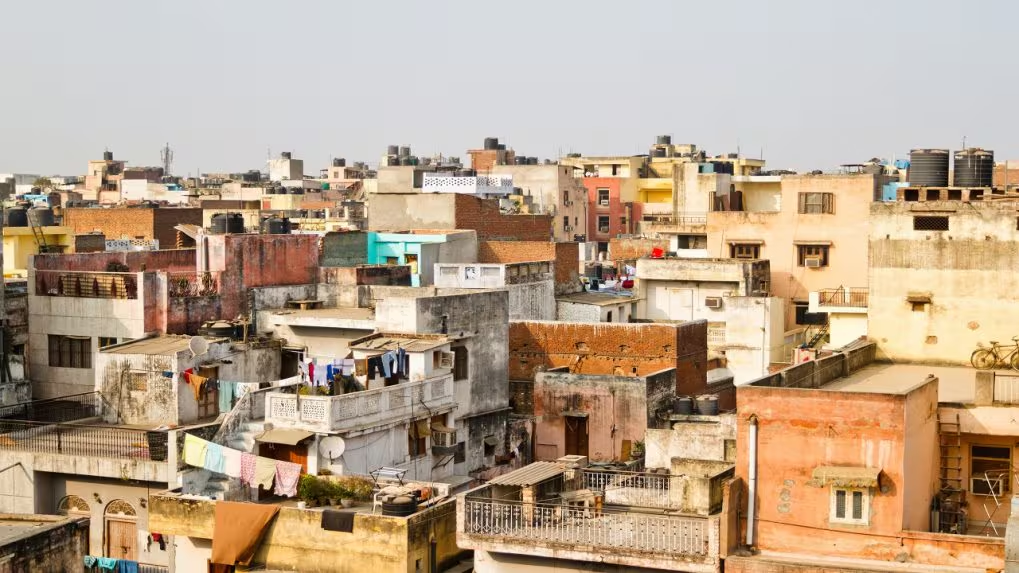
Delhi’s residential neighbourhoods are undergoing a quiet but consequential transformation, exposing deeper questions about how India’s capital has grown, adapted, and struggled to balance memory with modern urban pressures. Across older colonies and post-Independence settlements, low-rise homes designed for climate responsiveness and family life are rapidly giving way to vertically intensified structures, driven less by choice than by regulatory and market compulsions.
The city’s housing form has always mirrored its social history. Archaeological layers around central Delhi reveal continuous domestic settlement stretching back thousands of years, while medieval neighbourhoods still coexist with contemporary urban life. Yet Delhi’s most defining residential moment arrived after 1947, when the city absorbed a massive influx of displaced families following Partition. Within a few years, the population nearly doubled, forcing the young republic to respond at unprecedented speed. Government-led planning institutions and cooperative housing models produced a generation of neighbourhoods across south, west and central Delhi. These homes were compact, function-led and rooted in climate logic. Shaded verandahs, internal courtyards, breathable facades and adaptable rooftops reflected both environmental understanding and social needs. Urban planners note that this period created a form of Indian modern housing that balanced affordability, dignity and resilience without heavy reliance on mechanical cooling.
That balance began to fracture in the past decade. Amendments to building regulations allowed additional floors and stilt parking on residential plots, fundamentally altering neighbourhood density patterns. Instead of distributing population growth through new housing typologies or peripheral expansion, density was absorbed by existing colonies. Homes built for two storeys were suddenly expected to carry four or five. This shift has had cascading effects. Structural retrofitting often proved impractical, pushing owners towards demolition and rebuilds. Small contractors replaced architects, and standardised designs overtook context-sensitive planning. Industry experts say the result is a homogenised housing landscape, increasingly dependent on air-conditioning, imported materials and sealed interiors raising long-term energy demand and reducing thermal comfort.
From a market perspective, the changes have also reshaped real estate behaviour. Vertical redevelopment offers homeowners a way to monetise limited land in a city with constrained housing supply. However, urban economists warn that this model externalises costs, placing pressure on local infrastructure, water systems and public space without proportionate upgrades. The erosion is not only physical. What is disappearing is a housing legacy that documented how Delhi adapted to climate, displacement and aspiration.
Planning specialists argue that residential conservation does not mean freezing neighbourhoods in time, but guiding growth through clear redevelopment frameworks, material life-cycle planning and incentives for low-carbon construction. As Delhi prepares for its next phase of urban expansion, the challenge is no longer just building more homes, but deciding what kind of city those homes will sustain. The answer will shape not only skylines, but the lived experience of millions who continue to define what it means to belong to the capital.
Delhi Housing Reveals Citywide Planning Faultlines