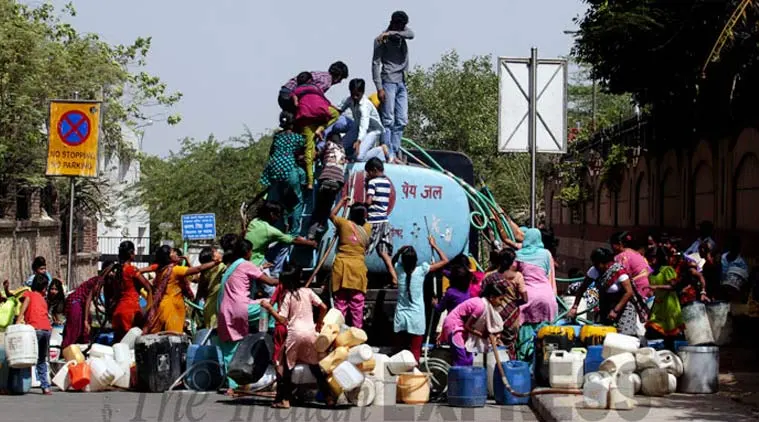
Delhi is preparing to launch a comprehensive citywide assessment of groundwater extraction as part of efforts to design a long-term water usage framework for a rapidly growing metropolis. The proposed exercise, expected to map borewells and quantify groundwater withdrawal across residential, commercial, and institutional zones, reflects rising concern within government over the capital’s narrowing water security margins.
Officials involved in planning say the survey will provide the first consolidated picture of how much groundwater Delhi is drawing, where stress is already visible, and how future extraction can be managed in a city facing sustained population growth and limited surface water options. The findings are expected to inform regulatory decisions as well as infrastructure investments tied to Delhi’s evolving urban form. Delhi currently depends on a combination of treated surface water and groundwater to meet daily demand. While the city’s treatment plants together produce close to 1,000 million gallons per day, groundwater continues to plug supply gaps through thousands of tubewells operating across neighbourhoods, industrial clusters, and large housing developments. Urban planners warn that this dependence has grown quietly, often outside systematic monitoring.
The Delhi groundwater survey is being positioned as a technical baseline for future policy, rather than an enforcement drive alone. A public sector consultancy with experience in water resource management has been engaged to carry out the assessment, which will include spatial mapping, extraction estimates, and identification of critical depletion zones. Officials say the data will help distinguish between essential usage and unsustainable withdrawal, enabling more targeted interventions.Pressure on groundwater is expected to intensify as Delhi’s population expands in coming decades. Projections used by planners suggest the city could add several million residents by the middle of the century, pushing daily water demand well beyond current supply capacity. With no major new river sources on the horizon, groundwater risks becoming the default buffer a trend experts say is environmentally and economically risky.
Urban development patterns are compounding the challenge. Higher densities planned under transit-oriented development, land pooling, and redevelopment schemes are reshaping demand geography. “Water planning can no longer be separated from land use planning,” said an urban infrastructure specialist. “If extraction continues unchecked, it will directly affect building viability, public health, and long-term resilience.”
The Delhi groundwater survey is also expected to influence future building norms, rainwater harvesting enforcement, and reuse strategies within both public and private developments. For real estate markets, clearer water availability signals could shape project feasibility and investment decisions.As climate variability, urban expansion, and consumption pressures converge, policymakers view the survey as a necessary reset. The next phase, officials indicate, will be translating data into enforceable, transparent rules that balance growth with ecological limits a test Delhi will need to pass to secure its water future.
Delhi Groundwater Survey Signals Water Policy Shift