


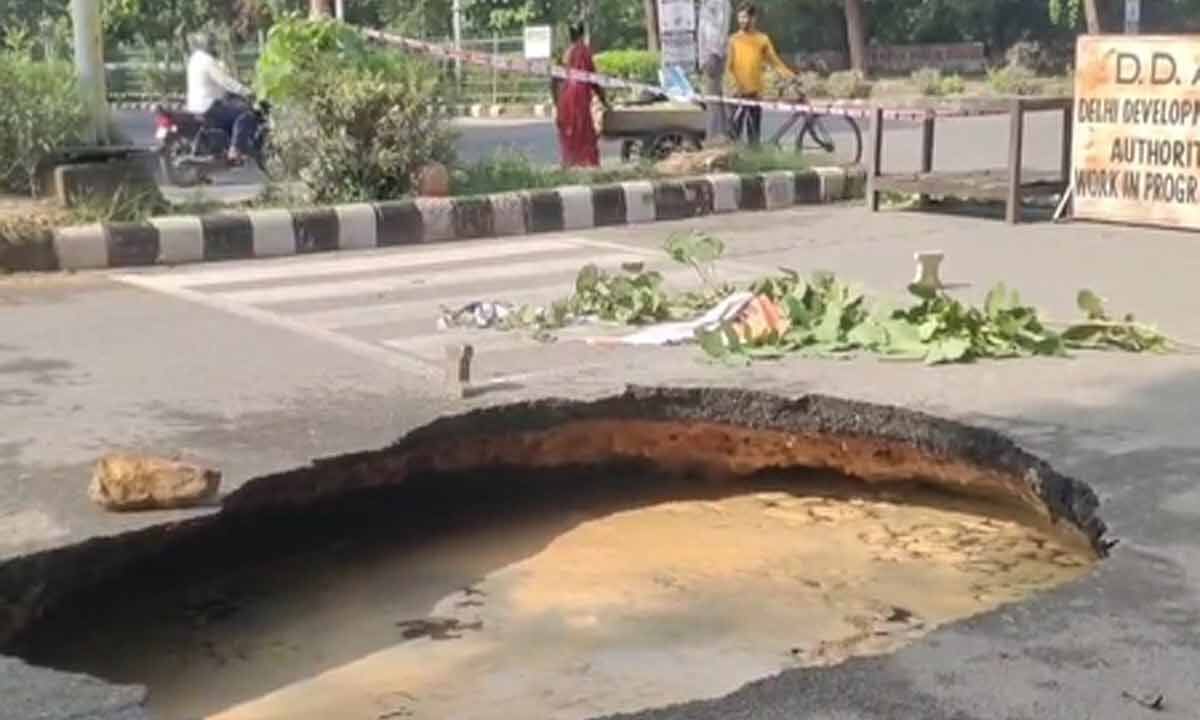
A busy road near the National Law University in Dwarka, New Delhi, caved in on Sunday morning after intense rainfall, leaving behind a massive crater that almost swallowed a vehicle. Fortunately, no casualties were reported. The incident, however, reignited sharp questions on the fragility of the capital’s road infrastructure and the repeated failures in civic planning.
The collapse disrupted traffic in Dwarka, one of the city’s busiest residential and institutional hubs, amplifying long-standing concerns voiced by commuters and residents. Officials confirmed that preliminary inspections pointed towards waterlogging combined with substandard construction quality as the probable causes of the incident.This is not an isolated episode. Over the past few months, Delhi has witnessed multiple road cave-ins across different zones. Only last week, a car plunged into a sinkhole in Burari after the road surface gave way in a crowded marketplace. Earlier in February, a service lane collapse near KM Chowk in Dwarka Sector 12 resulted in another vehicle accident. While these mishaps did not result in fatalities, the frequency of such cave-ins has heightened public anxiety over road safety in the national capital.
Also Watch: An Exclusive Interview with Sanjeev Jaiswal (IAS), CEO MHADA
Experts in urban infrastructure argue that Delhi’s recurring road failures are a symptom of deeper planning lapses. Rapid urbanisation combined with inadequate drainage systems has left many roads vulnerable during the monsoon season. Continuous waterlogging weakens the soil foundation, while improper material use in construction accelerates structural fatigue. A senior infrastructure specialist noted that these cave-ins highlight the absence of robust monitoring mechanisms and the lack of accountability in civic maintenance.Residents of Dwarka, which has experienced repeated incidents, are now pressing for a sustainable overhaul of the city’s road management framework. Many argue that short-term patchwork repairs are no longer sufficient and demand stronger, eco-friendly engineering solutions, such as permeable road materials that can absorb rainwater and prevent structural weakening.
