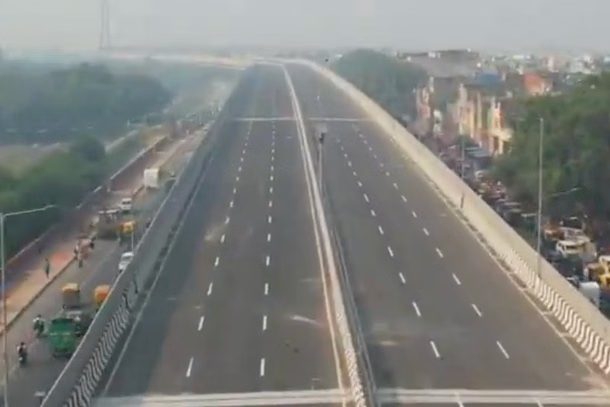
As construction enters its final stretch, the Delhi–Dehradun Expressway is beginning to shift from a mega infrastructure project to an operational transport corridor, with highway authorities rolling out structured parking systems along key sections. The move signals a broader effort to manage traffic behaviour, reduce roadside congestion and improve travel efficiency on a route expected to reshape mobility across northern India.
The 210-kilometre, six-lane greenfield expressway links the national capital with Uttarakhand’s primary urban and tourism centres. Once fully operational, it is expected to halve travel time between Delhi and Dehradun, a change with far-reaching implications for daily commuters, logistics operators and regional economies dependent on reliable road connectivity. New parking arrangements are being developed at strategic points along the expressway, including under elevated stretches and near dense commercial zones. According to officials involved in the project, designated parking facilities will cater separately to heavy vehicles, buses and private users through structured pass systems. The aim is to discourage informal roadside halts that often choke feeder roads and local markets, particularly in eastern Delhi and adjoining urban pockets.
Transport planners view the initiative as a shift towards access-managed highways, where movement, parking and logistics are planned together rather than treated as afterthoughts. For freight operators, organised parking reduces delays and safety risks, while for city residents it helps free up arterial roads that currently double up as informal truck terminals. The Delhi Dehradun Expressway has also been positioned as a test case for integrating large-scale road infrastructure with environmental safeguards. A significant elevated section passes through ecologically sensitive terrain, designed to maintain wildlife movement through underpasses and tunnels. Project planners say compensatory afforestation and rainwater harvesting systems have been built into the corridor to limit long-term ecological impact.
Real estate analysts note that improved highway discipline and predictable travel times could alter development patterns along the route. Industrial clusters, warehousing hubs and residential projects are already emerging near interchanges, particularly in western Uttar Pradesh. However, experts caution that growth must be guided by zoning controls and infrastructure capacity to avoid unplanned sprawl. The expressway is being delivered in multiple phases, with some stretches already undergoing trial runs. Full commissioning is expected in early 2026, subject to final safety audits and systems integration.
Once operational, the corridor will link seamlessly with other national highways and peripheral expressways, creating a high-speed network connecting Delhi with the wider north Indian region. Beyond speed, the project’s long-term value lies in how it manages demand. If parking controls, enforcement and last-mile connectivity function as intended, the Delhi Dehradun Expressway could set a benchmark for people-centric, climate-aware highway design one that supports economic growth without overwhelming cities at either end of the road.
Delhi Dehradun Expressway Parking Plan Takes Shape