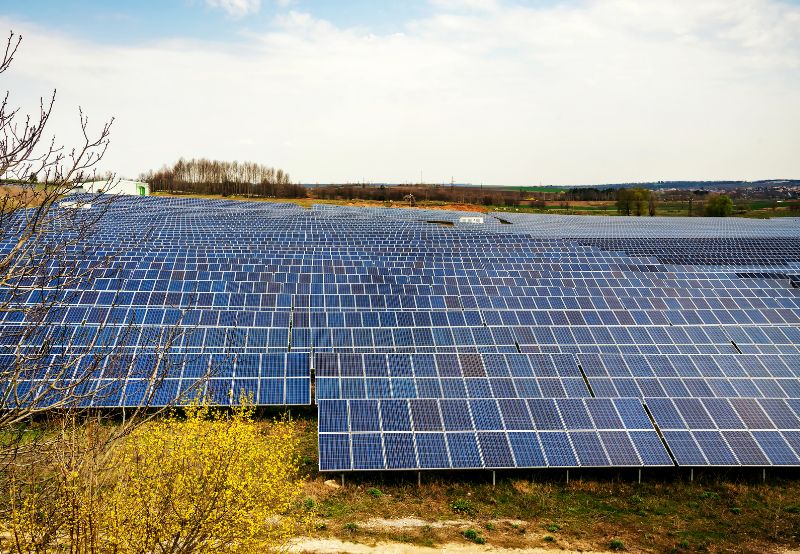
Delhi’s urban energy transition is set to gain momentum as the city’s development authority moves ahead with a utility-scale solar installation within a prominent public green space. The Delhi Development Authority has opened competitive bidding for a 2.2 megawatt solar carport project at Baansera Park near Sarai Kale Khan, marking a strategic step towards integrating renewable energy into high-visibility civic infrastructure.
The project is planned under a long-term service-based framework, with the selected developer responsible for financing, building, operating and maintaining the solar facility for 25 years. Power generated from the installation will be linked through net metering, allowing the authority to offset its electricity consumption while reducing dependence on conventional grid supply. For a city grappling with air quality and rising energy demand, the move reflects a growing emphasis on decentralised clean power within dense urban settings.
Urban planners view solar carports as a dual-use solution, combining energy generation with shaded parking and efficient land utilisation. At Baansera Park, a reclaimed urban landscape along the Yamuna floodplain, the project aligns with broader efforts to reimagine underused spaces as climate-responsive assets. Industry experts note that such installations can significantly lower operational costs for public agencies while visibly signalling commitment to low-carbon development. The execution timeline has been set at six months from award, indicating an intent to fast-track delivery. However, the longer operational responsibility placed on the developer underscores a lifecycle-based approach increasingly favoured in public infrastructure procurement. By tying performance to long-term operations, authorities aim to ensure reliability, efficiency and predictable output over decades rather than short-term capacity creation.
Eligibility norms outlined in the tender highlight the scale and seriousness of the project. Only developers with proven experience in commissioning grid-connected solar plants of comparable size are eligible, alongside clear financial stability benchmarks. Sector analysts say such criteria are designed to reduce execution risk, particularly for projects embedded within active public spaces where delays or underperformance can have reputational and operational consequences.
The bidding structure follows a two-stage evaluation, separating technical capability from financial competitiveness. This approach, commonly used for complex infrastructure assets, allows public agencies to prioritise quality and experience before tariff considerations. The requirement of an earnest money deposit and performance guarantees further reflects the authority’s focus on accountability and delivery certainty.
Beyond its immediate energy output, the project carries wider implications for Delhi’s urban development strategy. Public bodies are among the city’s largest electricity consumers, and incremental shifts towards onsite renewable generation can have a meaningful impact on emissions and operating budgets. Analysts suggest that if replicated across transport hubs, parks and institutional campuses, similar solar installations could cumulatively add significant clean capacity without competing for scarce land. As bidding progresses over the coming days, the Baansera Park initiative is being watched as a test case for how Indian cities can mainstream renewable energy into everyday urban infrastructure. The outcome could influence future procurement models and reinforce the role of public agencies as anchor customers in the country’s clean energy transition.
Delhi DDA Solar Carport Bid Signals Clean Shift