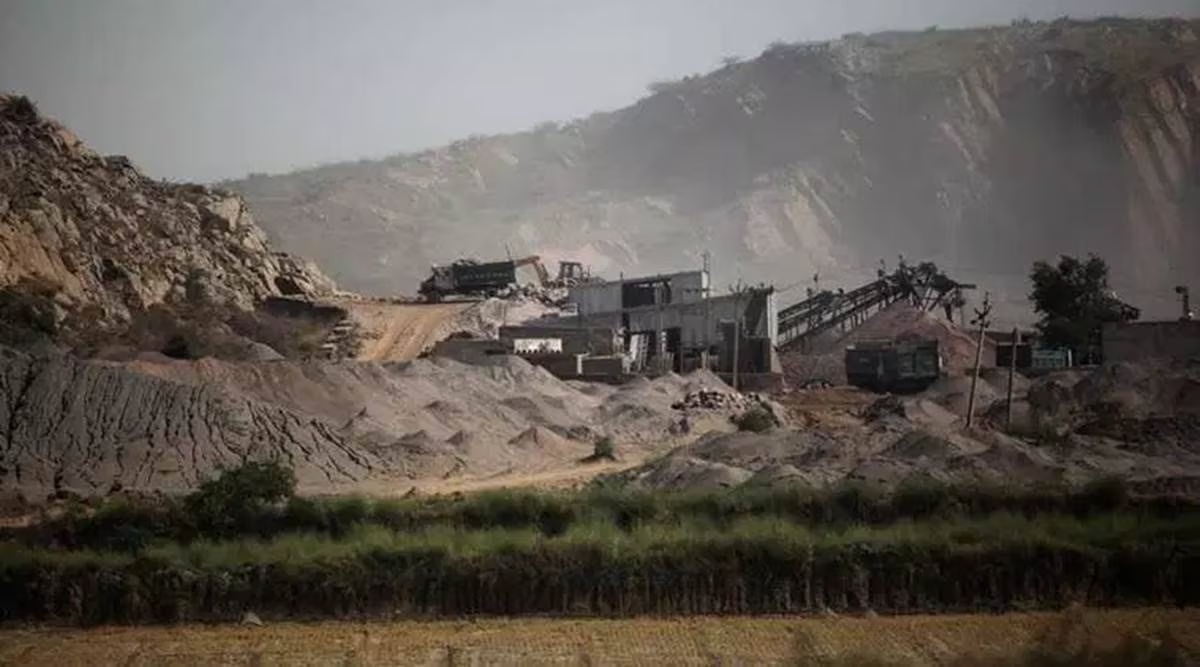
The Union environment ministry has clarified that mining in the Aravali Hills remains strictly regulated, with no relaxation for landforms under 100 metres in height. Union Minister Bhupender Yadav confirmed that only a fraction—0.19%—of the 1.44 lakh sq km Aravali region is eligible for mining, while the rest, spanning Delhi, Haryana, Rajasthan, and Gujarat, remains protected. The policy ensures the ecosystem’s slopes, water recharge zones, and vegetation cover are safeguarded from exploitation.
The Aravali Hills, one of India’s oldest geological formations, extend over four states and provide vital ecological services, including soil stability, groundwater recharge, and biodiversity support. Yadav explained that all landforms within 500 metres of two adjoining hills exceeding 100 metres in height, regardless of slope or local relief, are automatically excluded from mining leases. This definition, recently endorsed by the Supreme Court, is intended to standardise regulation while preserving sensitive ecological units from piecemeal extraction.Only a very limited portion of the Aravali range, mostly in Rajasthan, is currently under mining leases. Approximately 90% of ongoing extraction occurs in Rajasthan, followed by 9% in Gujarat and 1% in Haryana, with Delhi remaining fully off-limits. The uniform criterion of 100 metres above local relief was already in practice in Rajasthan and has now been adopted by all Aravali states and union territories to make mining regulation more transparent and objective.
Despite ministerial clarification, opposition leaders have raised environmental concerns. Congress general secretary Jairam Ramesh warned that the new definition could have long-term ecological and public health implications, suggesting it may leave significant sections of the Aravali unprotected in practice. Former Rajasthan Chief Minister Ashok Gehlot also criticised the move, arguing that it might undermine decades of conservation efforts.Environmental experts acknowledge that while the uniform framework simplifies oversight, careful enforcement will be essential to prevent ecological damage. “The protected slopes and foothills of the Aravali are critical for groundwater recharge and controlling soil erosion. Even limited mining outside the strictly permitted zones could have cascading environmental impacts,” said a senior urban planner familiar with the region.
The ministry maintains that with over 99% of the Aravali secured from extraction, the focus should now be on restoration of degraded areas and sustainable land management. Analysts suggest the framework could serve as a model for other ecologically sensitive hill ranges in India, demonstrating how resource extraction and ecosystem protection can coexist. The policy also aligns with broader urban sustainability objectives, supporting resilient, inclusive, and zero-carbon city development across the region.