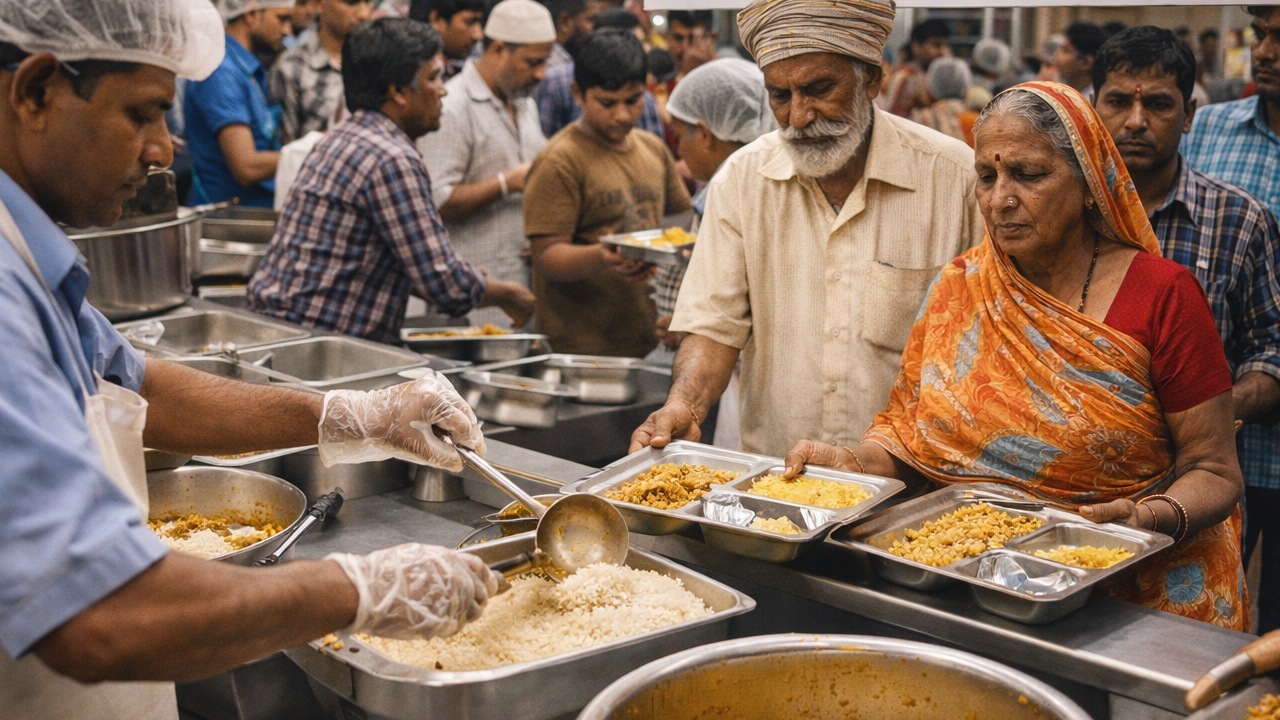
Delhi Community Kitchen Links Food Waste And Hunger
A youth-led initiative in Delhi is attempting to address one of the capital’s most persistent urban challenges: the coexistence of large-scale food waste and widespread hunger. The effort centres on a community-driven food redistribution model designed to redirect surplus meals from the hospitality sector to underserved communities across the city.
The project, known as a Delhi community kitchen initiative, was launched by a student social entrepreneur who sought to tackle food insecurity through partnerships with restaurants, hotels and local organisations. By collecting unused food from events and hospitality venues and redistributing it to vulnerable groups, the initiative attempts to reduce waste while improving access to meals for people facing food shortages. Urban food inequality remains a major issue in India despite significant agricultural production. According to data cited in the report, the country ranked 105th out of 127 nations in the Global Hunger Index 2024, reflecting ongoing challenges linked to poverty, unemployment and uneven distribution of food resources.
The Delhi community kitchen initiative focuses on building a collaborative ecosystem rather than operating as a traditional charity kitchen. Organisers have worked with hospitality partners and volunteer groups to identify surplus food from large gatherings and redistribute it through a coordinated network. The approach attempts to transform what would otherwise be discarded into meals for communities experiencing food insecurity. Early collaborations have already delivered hundreds of meals to vulnerable residents in parts of the National Capital Region. In one example, partnerships with hospitality venues and non-profit organisations enabled food prepared for large events to be redirected to people who otherwise lacked regular access to nutritious meals.
Urban planners say the model highlights a growing recognition that food waste and hunger are interconnected urban policy issues. Large cities often generate significant volumes of unused food from restaurants, hotels and social functions, even as sections of the population struggle to access daily meals. Food redistribution programmes are increasingly being explored worldwide as a practical strategy to bridge this gap. Another component of the initiative involves building a digital network that connects event planners, hotels and community groups involved in food redistribution. The goal is to create an open database that can streamline coordination between those with surplus food and organisations capable of distributing it to communities in need.
Experts in urban sustainability note that such models can support broader city goals. Redirecting surplus food reduces landfill waste and associated emissions while also improving social welfare outcomes. In densely populated cities like Delhi, where informal settlements and low-income communities often face food insecurity, localised food-sharing networks can provide a flexible safety net. The initiative also reflects the growing role of youth entrepreneurship in tackling urban social challenges. As cities expand and consumption patterns change, younger innovators are experimenting with community-based solutions that combine technology, partnerships and civic participation.
While still in its early stages, the Delhi community kitchen initiative illustrates how local action can address systemic urban problems such as food waste and hunger simultaneously. If scaled through broader collaboration with municipal authorities, hospitality businesses and non-profit organisations, similar models could help cities transform surplus food into a critical resource for communities in need.