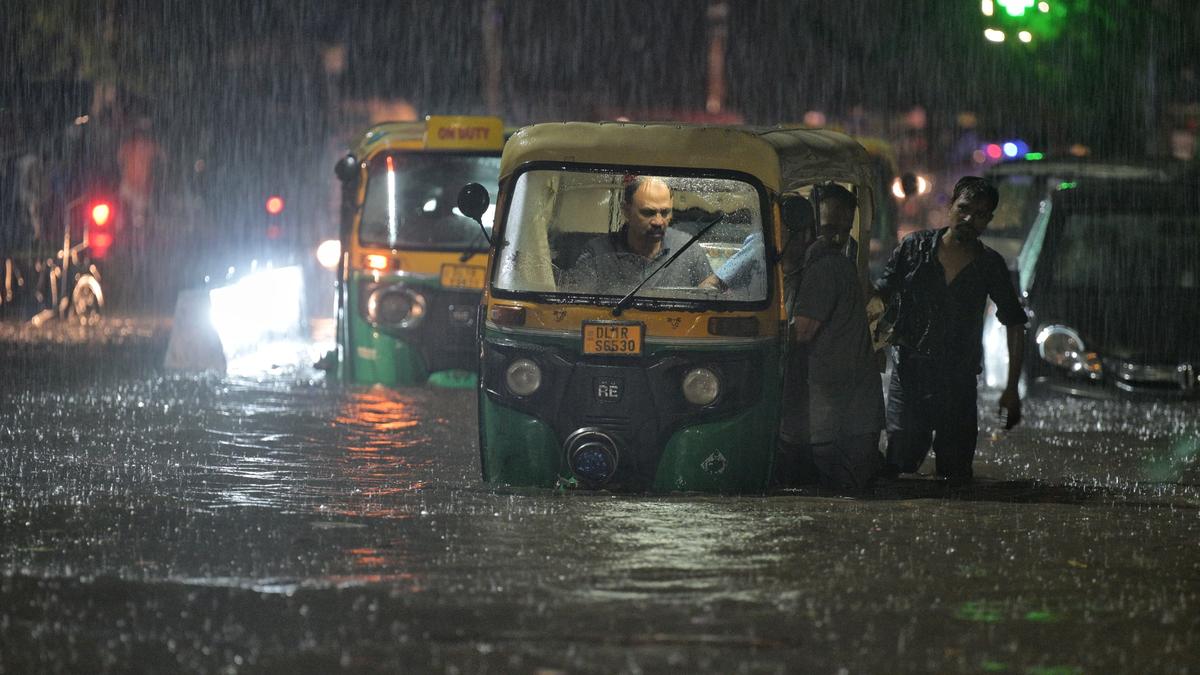
Delhi Braces For More Showers After Day Of Rain Havoc
Delhi awoke on Saturday to an intense spell of rainfall that brought the capital to a near standstill, crippling road and air travel while triggering fresh warnings from weather officials. The India Meteorological Department (IMD) signalled more showers ahead, cautioning residents to prepare for further disruptions.
From the city’s central government precincts to bustling commercial districts, waterlogging paralysed movement. Areas such as Shastri Bhawan, R.K. Puram, Moti Bagh, and Kidwai Nagar were drenched, with stretches like Mathura Road and the vicinity of Bharat Mandapam’s Gate No. 7 submerged after early morning downpours. Commuters also reported slow-moving traffic or complete standstills on key arterial roads including Panchkuian Marg and parts of Connaught Place.Flight schedules were hit as rain clouds lingered over the city’s airspace. According to flight monitoring data, close to 90 flights were delayed while a handful were cancelled. Airline operators, acknowledging passenger frustration, issued advisories urging travellers to arrive at the airport well ahead of departure times and to consider alternate routes due to extensive road blockages. Major carriers confirmed that delays were directly linked to adverse weather and the cascading traffic impact.
Meteorological experts forecast continued rainfall through the day, with temperatures hovering at a maximum of 33°C and dipping to 25°C. The IMD issued an orange alert for specific northern hill districts, signalling possible heavy rainfall, alongside a yellow alert for surrounding areas, raising concerns about regional travel and safety.The capital’s recent weather patterns have drawn attention from climate scientists, who note that Delhi is witnessing one of its wettest monsoon seasons in decades. They attribute the severe rainfall episodes to shifts in monsoon dynamics, compounded by urban heat island effects and inadequate stormwater infrastructure. Such climatic volatility not only strains mobility but also underscores vulnerabilities in urban planning, particularly as the city works towards climate-resilient infrastructure.
For daily wage workers, taxi drivers, and small business owners, the disruption proved particularly costly. With clogged roads and grounded flights, income opportunities were curtailed, adding an economic dimension to the environmental challenge. Authorities have advised residents to stay updated on traffic advisories, avoid low-lying areas, and remain vigilant as further downpours are expected over the weekend. While the immediate concern is clearing waterlogged stretches and restoring smooth movement, urban policy experts stress the long-term imperative: a stronger investment in sustainable drainage systems, better rainwater harvesting, and citywide flood mitigation strategies. Until such measures are implemented at scale, episodes like this will likely remain an annual ordeal for the capital’s residents.