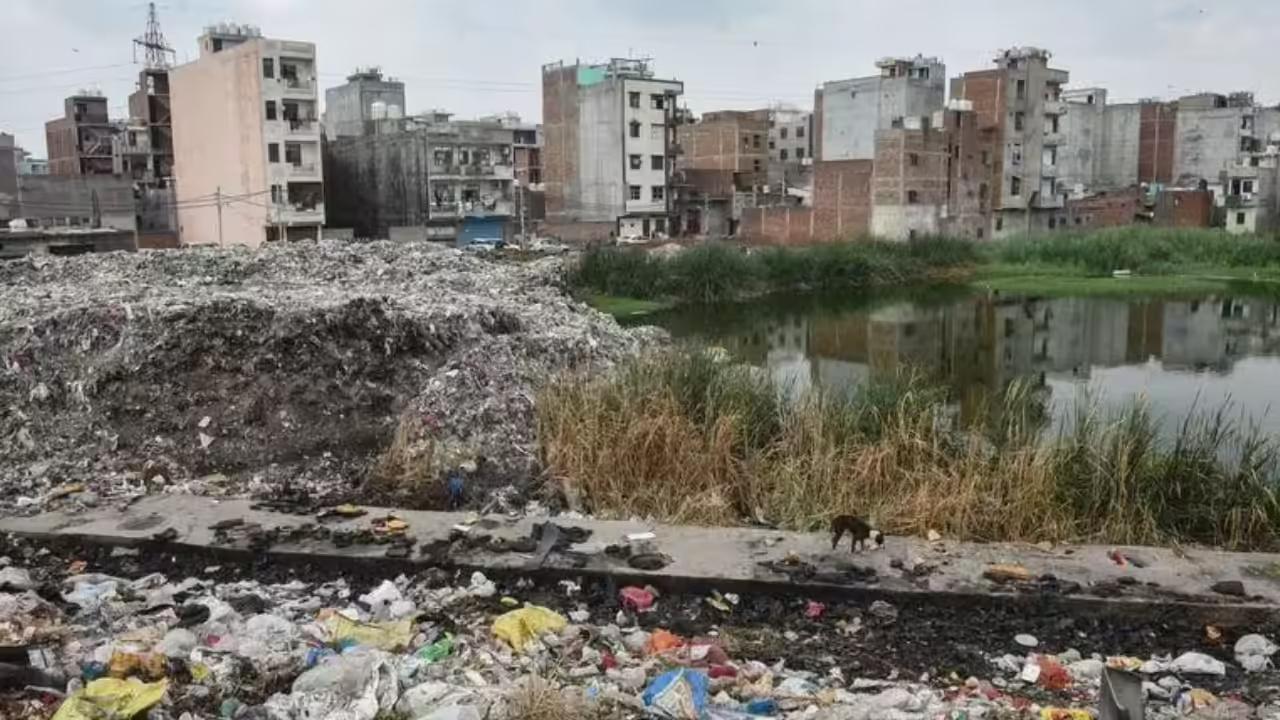
A contested patch of low-lying land in north Delhi has become the centre of a wider debate on urban ecology, land classification, and institutional accountability, after the city’s planning authority informed the National Green Tribunal that the site in question was never recorded as a wetland or water body. The submission challenges claims that a pond was buried during waste remediation activities linked to a nearby landfill, raising critical questions about how cities identify, protect, and restore natural drainage systems.
The case stems from tribunal proceedings initiated after reports suggested that inert material from landfill bio-remediation had been used to fill what residents believed to be a traditional pond near Wazirabad. Environmental regulators subsequently sought explanations from multiple civic and environmental agencies, reflecting growing scrutiny over how urban waste management intersects with ecological protection. In its response, the land-owning authority stated that official acquisition and possession records do not identify the site as a pond, johad, or wetland. According to the submission, the parcel was acquired decades ago from a private owner and has consistently been classified as non-water land in government documentation. Officials described the area as a natural depression that temporarily accumulates rainwater during the monsoon rather than a perennial or designated water body.
Urban planners say the distinction carries significant implications. “In cities like Delhi, many natural depressions act as seasonal water buffers even if they are not formally notified wetlands,” an environmental planning expert noted. Such spaces often play an important role in groundwater recharge, flood moderation, and microclimate regulation, especially as urbanisation reduces permeable surfaces. The dispute also highlights long-standing gaps in wetland mapping and land-use classification. While regulatory frameworks rely heavily on historical revenue records, environmental experts argue that rapid urban expansion has altered hydrology in ways that older documentation may not capture. As a result, sites that function ecologically as wetlands today may fall outside legal protection, leaving them vulnerable to dumping, construction, or infrastructure projects.
From a governance perspective, the tribunal’s intervention reflects increasing judicial oversight of urban environmental management. Waste remediation, though essential for public health and land recovery, has faced criticism for insufficient coordination between municipal agencies, land authorities, and pollution regulators. When undertaken without clear ecological assessments, such projects risk shifting environmental burdens rather than resolving them. The Wazirabad case also feeds into broader concerns about Delhi’s shrinking network of water bodies. Over the past few decades, numerous ponds and lakes have disappeared due to encroachment, landfill expansion, and infrastructure development. Climate resilience experts warn that losing even seasonal water-holding areas can worsen urban flooding and heat stress, particularly as rainfall patterns become more erratic.
As proceedings continue, the tribunal is expected to examine both documentary evidence and on-ground conditions before determining accountability or corrective action. The outcome could influence how cities balance formal land records with functional ecological value, shaping future approaches to wetland protection, waste management, and climate-resilient urban planning.
Delhi Authority Disputes Wetland Claim At Wazirabad Site