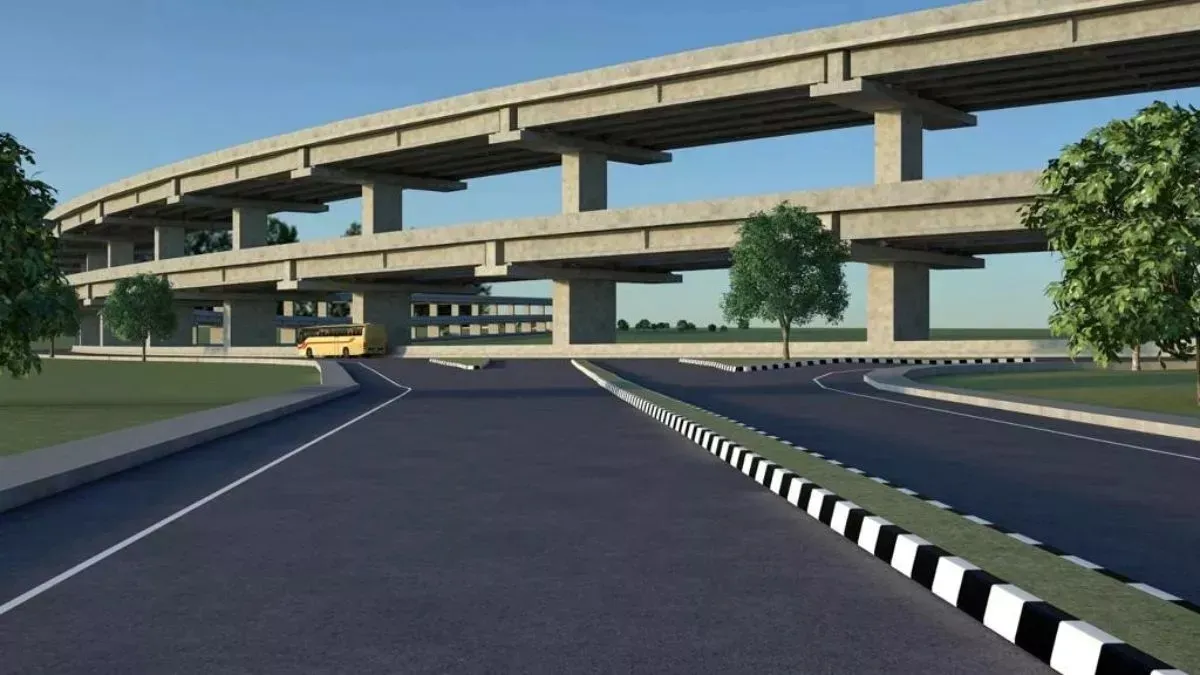
Delhi has cleared a major transport infrastructure investment to tackle chronic congestion along one of South Delhi’s busiest arterial corridors. The city’s Expenditure Finance Committee has approved a ₹1,471.14 crore six-lane elevated road project on Mehrauli Badarpur (MB) Road, stretching from Saket G-Block to Pul Prahladpur, in a move aimed at improving mobility, cutting travel times and easing pressure on surface roads in dense residential and commercial zones.
The elevated corridor, spanning nearly five kilometres, will be developed in two phases. The first section will run from Saket G-Block to Sangam Vihar, covering about 2.42 kilometres, while the second stretch will extend from Maa Anandmayee Marg to Pul Prahladpur, measuring approximately 2.48 kilometres. Officials said the project has been structured to maximise capacity within limited right-of-way, a recurring constraint in South Delhi’s built-up neighbourhoods. Execution of the project has been entrusted to the Delhi Metro Rail Corporation, reflecting a growing trend of leveraging metro engineering expertise for complex urban road structures. The elevated road will follow the metro corridor alignment and feature a double-decker configuration, with metro services operating on the upper deck and a six-lane vehicular roadway below. Two underpasses are also planned at Saket G-Block and along the BRT corridor to streamline surface traffic movement.
Urban planners involved in the review process said the integrated design is intended to reduce land acquisition requirements while improving coordination between road and rail infrastructure. “Stacking transport modes vertically is one of the few viable ways to expand capacity in land-scarce corridors like MB Road,” said a senior infrastructure advisor. The MB Road elevated road project is expected to bring relief to commuters from high-density localities such as Saket, Ambedkar Nagar, Khanpur and Sangam Vihar, where peak-hour congestion routinely spills over into residential streets. Traffic engineers estimate that average vehicle speeds on the corridor could rise significantly once through-traffic is shifted to the elevated deck, freeing surface roads for local access and public transport.
Beyond mobility, the project carries broader economic and real estate implications. Improved connectivity along MB Road is likely to enhance the attractiveness of surrounding micro-markets, particularly for mixed-use development and affordable housing clusters that depend on reliable road access. Industry experts caution, however, that construction-phase disruption will need careful traffic management to avoid short-term productivity losses for local businesses. An in-principle approval has also been granted for an additional six-lane elevated stretch of around 2.5 kilometres between Sangam Vihar and Maa Anandmayee Marg. This extension is subject to clearance from the Ministry of Culture, as the proposed alignment falls within the regulated zone of Tughlaqabad Fort. Heritage-sensitive design and regulatory coordination will be critical if the corridor is to be extended without legal or environmental setbacks.
From a sustainability perspective, transport analysts say elevated roads should be paired with strong public transport integration to avoid inducing more private vehicle use. “Capacity expansion alone will not solve congestion in the long run unless it is complemented by metro, bus and last-mile connectivity improvements,” said an urban mobility researcher. The MB Road elevated road project is targeted for completion by December 2027. As Delhi continues to grapple with rising vehicle ownership and spatial constraints, the success of this corridor will be judged not just by speed gains, but by how well it supports a more efficient, climate-resilient and people-first urban transport system.
Delhi Approves MB Road Elevated Corridor