


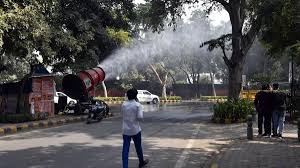
The Delhi government has approved a comprehensive ₹2388 crore plan aimed at mitigating road dust pollution over the next 7 to 10 years. This initiative, sanctioned by the Delhi Cabinet, underscores the administration’s commitment to enhancing air quality and public health through advanced technological interventions. The project entails the procurement and deployment of 70 mechanical road-sweeping machines and 250 water sprinkling machines equipped with integrated anti-smog guns.
These machines will be strategically stationed across Delhi’s 1,449-kilometre road network managed by the Public Works Department (PWD). Each of Delhi’s 70 assembly constituencies will be allocated one mechanical road-sweeping machine, while the 250 water sprinklers will correspond to the city’s municipal wards. The mechanical sweepers are designed to efficiently clean road surfaces, significantly reducing the accumulation of dust and particulate matter. When complemented by water sprinklers, which will utilize treated sewage water provided by the Delhi Jal Board, the combined effect is expected to substantially lower PM10 and PM2.5 levels, contributing to improved air quality.
The PWD will oversee the implementation and maintenance of this project, ensuring that the machinery operates effectively across the designated areas. The deployment of these machines will be conducted in three shifts daily, maximizing coverage and operational efficiency. Additionally, the PWD plans to employ Geographic Information System (GIS)-based heat mapping to monitor dust control measures along its 4,200-kilometre road network, facilitating targeted interventions in areas with high dust generation. While the initiative has garnered approval, its success hinges on effective coordination among various municipal agencies. The Municipal Corporation of Delhi (MCD) has previously expressed concerns regarding the execution of dust suppression projects, citing sanitation as its core responsibility. However, the PWD has now been entrusted with the task, with the support of the Delhi Jal Board for water supply, to ensure a streamlined and focused approach.
The project also aligns with the Delhi government’s broader environmental action plan, which includes the deployment of AI-enabled systems for monitoring construction and demolition activities, installation of anti-smog guns at high-rise buildings, and the introduction of RFID tag readers to track vehicular emissions. These measures collectively aim to address multiple sources of pollution and enhance the city’s overall air quality. Public participation and awareness are crucial for the success of such large-scale environmental initiatives. The Delhi government plans to engage with residents and community organizations to ensure active involvement in dust control measures and to encourage responsible practices that contribute to cleaner air.
As Delhi continues to grapple with air pollution challenges, this ₹2388 crore investment represents a proactive and multifaceted approach to urban environmental management. By integrating technology, infrastructure, and community engagement, the city aims to pave the way for a healthier and more sustainable urban future.
Also Read: India Cities Drive Net Zero Transformation
