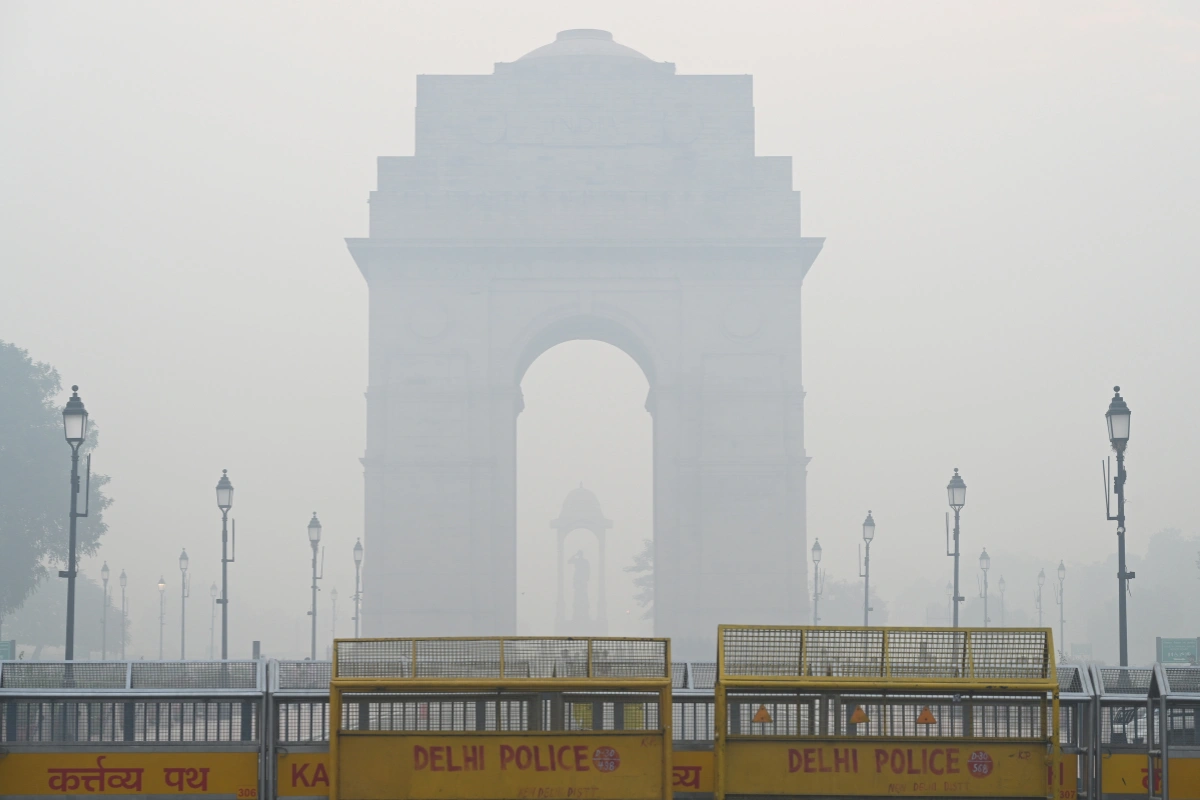
Delhi’s air quality showed fresh signs of stress on Monday morning as pollution levels edged into the ‘poor’ category, underlining the city’s continued vulnerability to winter meteorological conditions and uneven emission sources. According to official monitoring data, the citywide Air Quality Index crossed the 200 mark, a level that begins to pose health risks for sensitive groups and disrupts daily life in several densely populated neighbourhoods.
The deterioration followed a brief period of relatively stable conditions, with pollution levels fluctuating between the upper end of the ‘moderate’ range and the lower ‘poor’ band over the weekend. Environmental scientists attribute the shift largely to calm winds, high humidity and shallow atmospheric mixing a familiar winter pattern that limits the dispersion of pollutants across the National Capital Region. The impact was not uniform across the city. Industrial and transport-heavy zones in north and west Delhi recorded significantly higher pollution levels, with several monitoring stations reporting AQI readings well above the city average.
These areas, characterised by logistics hubs, dense housing and arterial road networks, tend to experience sharper spikes when meteorological conditions restrict air movement. In contrast, central and southern corridors with more open spaces and institutional land use reported comparatively better air quality, though still above ideal thresholds. Urban health experts caution that even short-term exposure to ‘poor’ air quality can aggravate respiratory conditions, reduce outdoor activity and increase healthcare costs. For daily wage workers, street vendors and delivery personnel, such fluctuations translate into both health and economic risks. The recurring winter pollution cycle also highlights deeper structural issues in how Indian cities manage transport emissions, construction dust and industrial activity during adverse weather conditions.
From an urban planning perspective, the episode reinforces the need for integrated pollution management rather than episodic responses. Analysts note that while emergency measures often draw attention during severe smog events, sustained improvement depends on long-term investments in cleaner public transport, electrification of freight movement, and better enforcement of land-use zoning. Neighbourhood-level variations in air quality further point to the importance of decentralised monitoring and localised mitigation strategies. The current conditions also have implications for real estate and infrastructure development. Developers and institutional investors increasingly factor air quality trends into project planning, particularly for residential and mixed-use developments. Poor air quality can affect property valuations, occupancy patterns and demand for indoor air filtration systems, adding hidden costs to urban living.
Weather forecasts suggest that pollution levels may continue to fluctuate in the coming days, depending on wind speed and temperature changes. Urban planners argue that while seasonal factors are unavoidable, their impact can be softened through structural reforms that reduce baseline emissions. As Delhi continues to expand its transport and housing footprint, the challenge lies in aligning growth with cleaner air outcomes, ensuring that environmental stress does not become an accepted feature of city life.
Delhi Air Quality Slips As Winter Conditions Persist