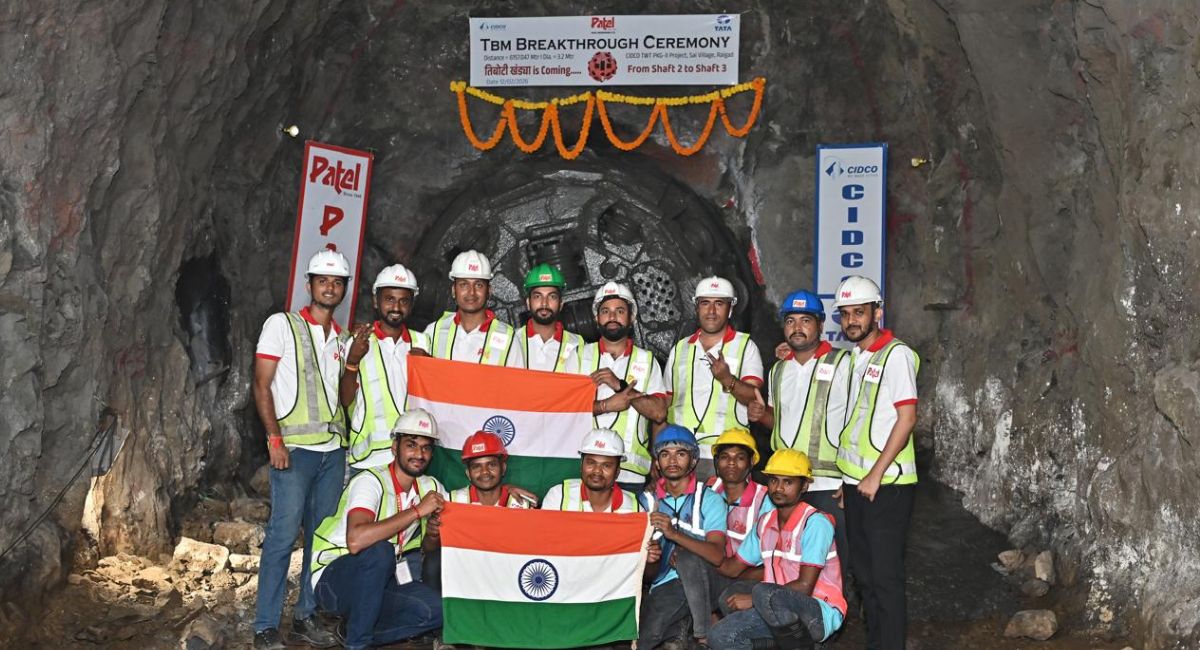
Navi Mumbai has reached a significant infrastructure milestone with the completion of a critical tunnelling phase under a key treated water project, reinforcing the city’s long-term water security strategy. The breakthrough, achieved on the outskirts of Panvel, marks a decisive step in strengthening bulk water conveyance for one of India’s fastest-growing planned urban regions, with implications for housing, industry, and climate resilience.
The underground drive forms part of a major treated water tunnel being developed by City and Industrial Development Corporation, the planning authority responsible for Navi Mumbai. According to project data reviewed by Urban Acres, the tunnel boring operation recorded the highest-ever monthly progress achieved by a mechanised tunnelling machine in India, underscoring both execution capacity and the increasing role of advanced construction technologies in urban infrastructure delivery. Officials overseeing the project said the completion of this phase several months ahead of schedule reduces execution risk for downstream works such as lining, mechanical installations, and integration with the wider water distribution network. Equally significant is the project’s safety record, with over a million man-hours logged without a major incident, a benchmark increasingly scrutinised by infrastructure lenders and urban authorities alike.
The tunnel itself is designed to carry treated water over more than six kilometres, linking supply infrastructure between villages in the Panvel region and southern Raigad district. Once commissioned, it is expected to enhance reliability in bulk water movement to Navi Mumbai, where population growth, real estate development, and industrial expansion continue to exert pressure on existing systems. Urban planners point out that underground conveyance systems offer long-term advantages over surface pipelines, particularly in dense or ecologically sensitive zones. By minimising land acquisition, surface disruption, and exposure to climate-related damage, such tunnels align with low-carbon and climate-adaptive infrastructure planning, even though they require higher upfront capital and technical expertise.
The project’s location near Panvel is also strategically important. Panvel is emerging as a critical junction for transport, logistics, and residential growth, especially with multiple regional infrastructure projects converging in the area. Reliable water infrastructure is considered foundational for sustaining this expansion without exacerbating inequity or environmental stress. Industry analysts note that timely delivery of core utilities such as water has a direct bearing on investor confidence in planned cities. Delays in bulk supply systems often translate into higher costs for developers and municipalities, ultimately affecting housing affordability and service quality for residents.
Looking ahead, attention will shift to the commissioning timeline, operational efficiency, and integration of the tunnel with treatment and distribution assets. For Navi Mumbai, the completion of this tunnelling phase is not just an engineering achievement but a reminder that invisible infrastructure beneath the city often determines the resilience, liveability, and economic sustainability of the urban environment above.
CIDCO Project Boosts Navi Mumbai Water Planning