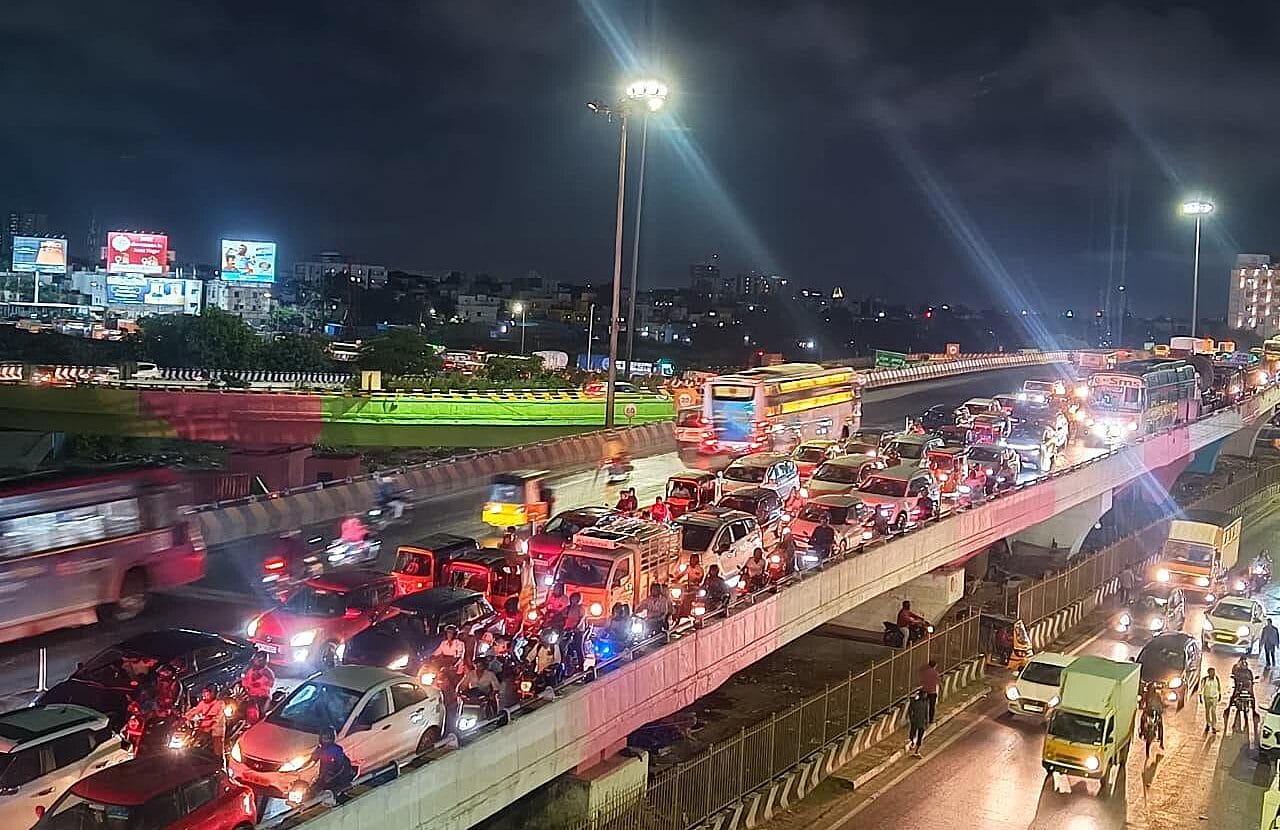
Even weeks after the inauguration of a major flyover linking Sardar Patel Road and Rajiv Gandhi Salai (OMR), traffic snarls persist at the Madhya Kailash junction, undermining the intended efficiency of the new infrastructure. Despite a multi-crore investment aimed at segregating through-traffic from local manoeuvres, a right-turn signal allowing vehicles from Sardar Patel Road to enter OMR remains active, creating severe bottlenecks during peak hours.
Urban planners note that flyovers are most effective when surface-level conflict points are eliminated. In Chennai’s case, vehicles turning right onto OMR must still pause mid-junction, forcing through-traffic from Adyar towards Anna University to stop intermittently. Commuters report queues stretching hundreds of metres, often lasting 15–20 minutes during afternoon peaks, signalling a mismatch between design intent and operational practice. A senior traffic official acknowledged that the right-turn could be restricted to encourage flyover use exclusively, but cited pending administrative review as a reason for inaction. Experts suggest that the delay reflects broader challenges in urban traffic governance, where physical infrastructure improvements are frequently undermined by inconsistent enforcement or legacy traffic patterns.
Economically, such inefficiencies have measurable impacts. Congestion at this junction not only increases travel time for thousands of daily commuters but also raises fuel consumption and emissions. In a city striving to promote zero-carbon transport and sustainable mobility, the continued stop-and-go flow at Madhya Kailash counters broader environmental objectives. Local businesses also report delays in logistics and client visits, hinting at indirect costs to commercial productivity. Socially, the persistence of traffic jams at a major arterial node underscores the need for integrated planning that aligns infrastructure with signal management and commuter behaviour. Observers highlight that flyover construction alone does not guarantee smoother traffic; operational adjustments, public awareness campaigns, and real-time monitoring are essential to achieve intended outcomes.
Urban development analysts emphasise that Chennai’s experience serves as a cautionary case for other rapidly growing cities investing heavily in elevated corridors. Without complementary enforcement and strategic traffic signal redesign, new infrastructure risks falling short of its potential. Authorities have indicated that a review of signal timings and turn restrictions is underway, with adjustments expected in the coming months. Until these operational changes are implemented, commuters are likely to continue facing avoidable delays, highlighting a persistent gap between planning, execution, and real-world urban mobility outcomes.