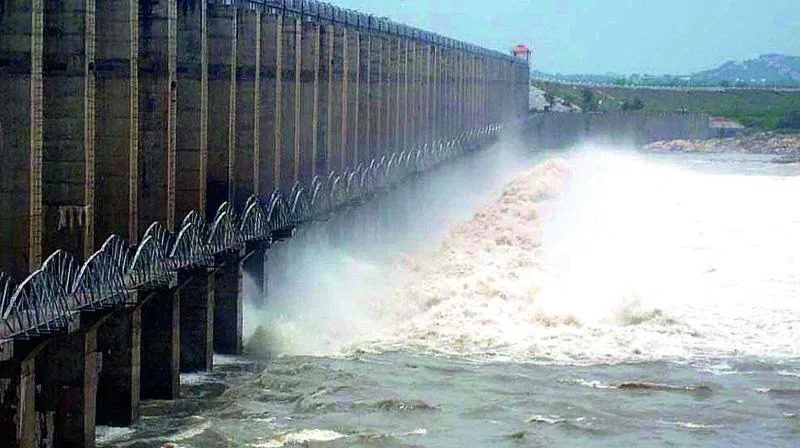
Chennai has begun strengthening its summer water buffer after fresh inflows from the Krishna basin entered the city’s reservoir network, offering relief ahead of peak seasonal demand. The additional volumes are expected to stabilise storage levels across key drinking water sources, supporting supply security in a metropolis where climate variability and rapid urbanisation continue to test infrastructure resilience. Water released from Andhra Pradesh’s Kandaleru reservoir last week has reached the Poondi reservoir, forming the backbone of the city’s current augmentation strategy. From there, flows are being channelled towards Red Hills and Chembarambakkam, helping maintain reservoir storage at roughly four-fifths of installed capacity even as daily withdrawals remain high.
Officials overseeing the system indicated that current inflows are averaging just over 400 cubic feet per second, with the possibility of increasing discharge in the coming days. If sustained through March, the Krishna water supply could contribute nearly 1,000 million cubic feet to Chennai’s storage matrix by month-end, significantly strengthening the city’s buffer before the onset of intense summer heat. For a city that currently distributes more than 1,200 million litres per day, including piped supply and tanker support, incremental storage gains are not marginal. Recent inflows alone have added close to 140 million cubic feet roughly equivalent to several days of metropolitan consumption. Urban planners note that such buffers are critical not only for domestic consumption but also for maintaining industrial activity and construction momentum during water-stressed months.
The Krishna water supply, delivered through the Kandaleru–Poondi canal system, is also shared with irrigation and drinking needs in towns along the route. While evaporation losses during transit are estimated at up to 10 per cent, water managers say canal lining and maintenance upgrades have helped minimise seepage this year. Scheduled maintenance of the canal network is planned in April, with flows expected to resume in early May. The timing of this augmentation underscores a broader shift in Chennai’s water governance model. After severe shortages in recent years exposed the risks of overdependence on monsoon rainfall, authorities have expanded a portfolio approach that includes inter-basin transfers, desalination plants, groundwater recharge and the restoration of local water bodies such as Thervoy Kandigai and Kannankottai.
Collectively, the city’s five principal reservoirs now hold over 80 per cent of their designed capacity, a relatively strong position entering summer. Yet experts caution that long-term water security will depend on reducing distribution losses, curbing unplanned urban sprawl that encroaches on catchments, and integrating climate projections into storage planning. For Chennai’s households, industries and real estate sector, the current inflow offers short-term reassurance. For policymakers, it reinforces the importance of coordinated interstate cooperation and resilient infrastructure investment in building a water-secure, climate-adaptive metropolis.