


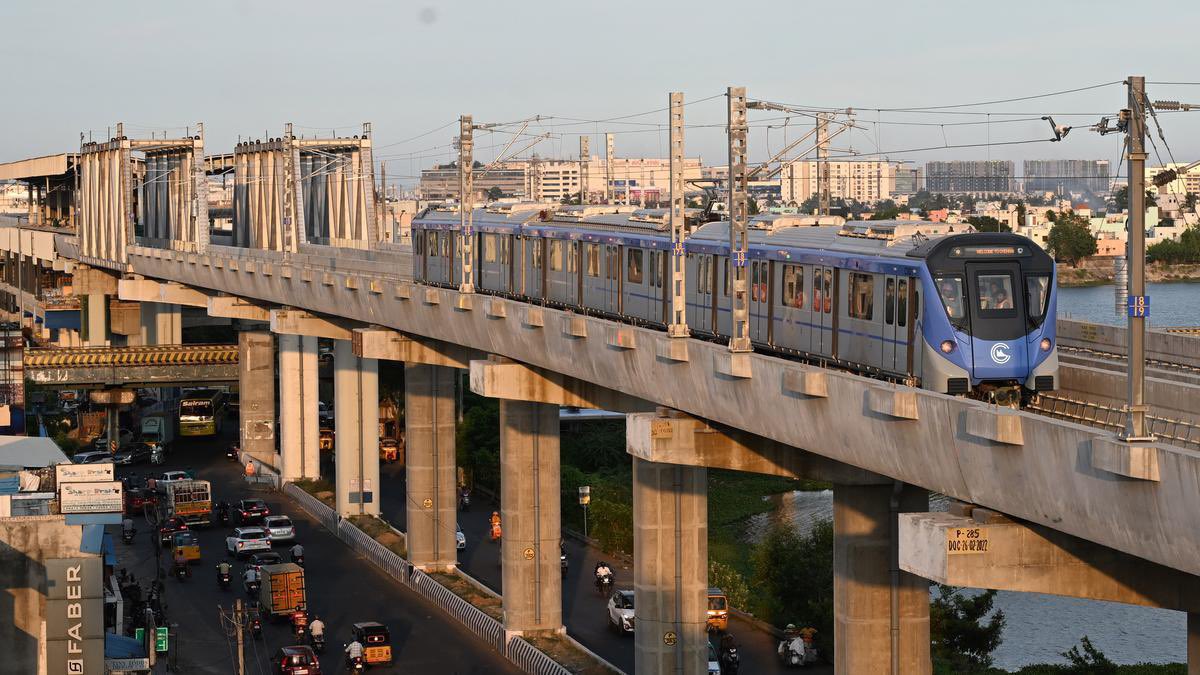
Chennai’s expanding rapid transit network crossed a critical operational milestone this week as Chennai Metro Rail completed a trial movement between Porur and Vadapalani, advancing the city closer to seamless east–west connectivity. The test run, part of Chennai Metro Phase II, signals that long-delayed western suburbs may soon gain faster, traffic-free access to the city’s core, reshaping daily commute patterns and easing pressure on arterial roads.
The tested stretch spans roughly 5.5 kilometres and includes one of Phase II’s most complex engineering segments a multi-level viaduct designed to carry metro lines above existing transport infrastructure. Urban transport planners say this section is particularly significant because it demonstrates how dense cities can add mass transit capacity without extensive land acquisition, an increasingly vital consideration for climate-resilient urban growth. Officials involved in the project indicated that the trial was conducted at controlled speeds as part of standard systems validation. Over the coming weeks, testing will gradually scale up to operational speeds, alongside signalling, braking, and power integration checks. This corridor forms a crucial link between Chennai Metro Phase II and the operational Phase I network, enabling passengers to switch lines and reach multiple employment and residential hubs without relying on private vehicles.
For commuters from the western edge of the city, particularly along the Poonamallee corridor, the extension is expected to cut travel times dramatically once passenger services begin. Transport economists note that predictable sub-30-minute journeys could influence housing choices, reduce congestion-related productivity losses, and lower vehicular emissions along one of Chennai’s most traffic-stressed corridors. Operational strategy remains a work in progress. While the Phase II system has been designed for high-grade automation, early services are expected to run with onboard drivers until safety certifications and regulatory approvals are fully secured. Rail safety clearance processes, including independent inspections, are currently underway an essential step before commercial operations can commence.
Station integration is another transitional challenge. With parts of the new Vadapalani Phase II station still under construction, interim passenger movement plans involve elevated walkways linking the new platforms to the existing metro concourse. Urban accessibility experts emphasise that such temporary arrangements must be carefully managed to ensure safe, inclusive movement for all users, including the elderly and people with reduced mobility. Beyond immediate commuter benefits, the corridor reflects broader urban ambitions. Chennai Metro Phase II is expected to support decentralised growth by connecting peripheral residential zones with established commercial districts, reducing the city’s dependence on road-based expansion. As more sections enter testing and commissioning phases, attention will shift to operational reliability, last-mile connectivity, and land-use coordination around stations.
If delivered as planned, the Porur–Vadapalani link could become a template for how Indian cities extend high-capacity transit through built-up areas quietly reshaping mobility, land values, and environmental outcomes without disrupting the urban fabric.
Also Read: Aurionpro Expands Metro Payments Footprint In Madhya Pradesh
