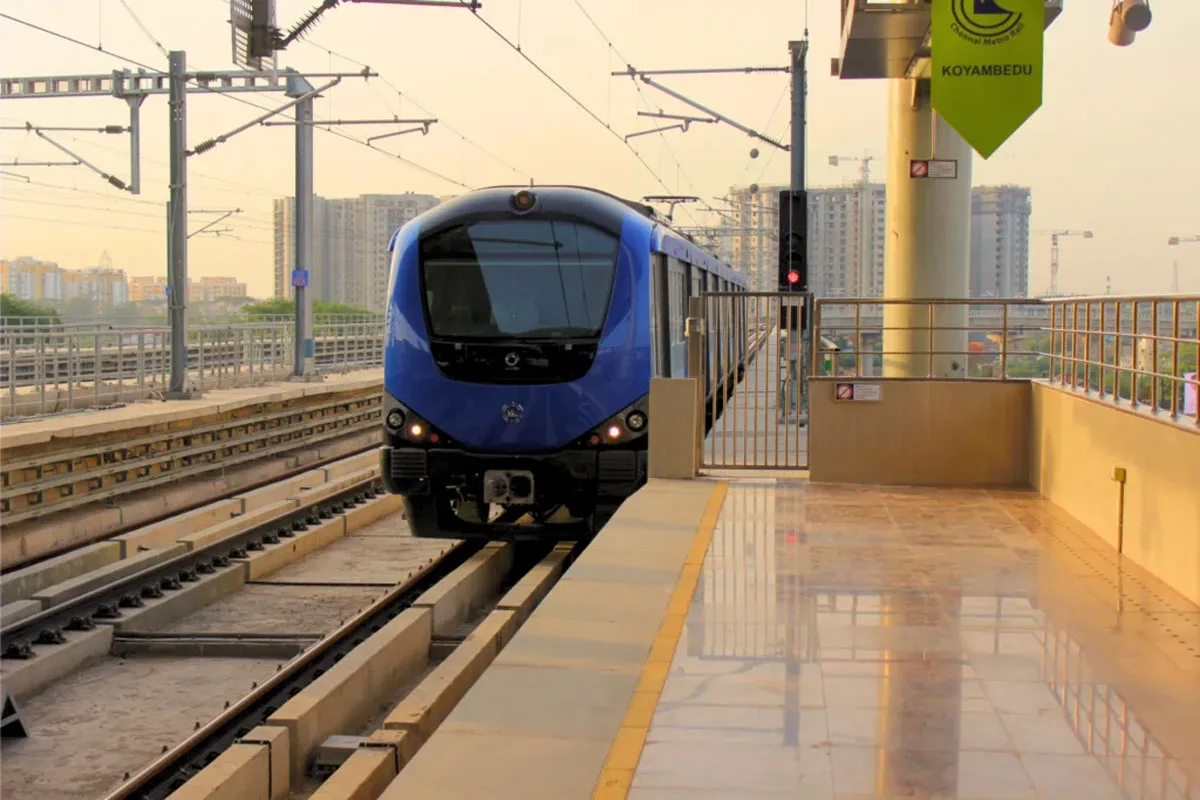
Chennai Metro Rail has awarded its ballastless track maintenance contract for Phase 1 and the Phase 1 Extension to United Rail Road Consultants, following a competitive bidding process. The contract, valued at ₹11 crore, covers the upkeep of elevated, underground, and depot sections, signalling a focused effort to ensure operational reliability and long-term asset sustainability across the city’s expanding metro network.
The agreement comes as Chennai Metro consolidates its 54.1 km operational network spanning the Blue and Green Lines, including the northern Phase 1 Extension, which added 9.05 km of elevated track in 2021. Industry experts note that proactive maintenance of ballastless tracks which offer reduced vibration and longer service life compared to traditional ballasted tracks is critical in high-density urban corridors where service disruptions can significantly impact daily commuters.
The tender process involved two bidders, with United Rail offering the lowest bid at ₹11 crore, narrowly beating PEMS Engineering Consultants, whose bid stood at ₹11.7 crore. Technical evaluation concluded on 6 February 2026, followed by financial bids opened on 6 March 2026. The award underscores Chennai Metro Rail Limited’s (CMRL) intent to balance cost-efficiency with the rigorous operational standards required for urban rail infrastructure in India’s fourth-largest city. From a civic perspective, this contract is more than routine maintenance; it reflects a broader urban mobility strategy prioritising reliable, energy-efficient public transport. Urban planners highlight that well-maintained ballastless tracks reduce energy consumption, minimise noise pollution, and support uninterrupted metro service a crucial factor for promoting a shift from private vehicles to public transport, thereby easing traffic congestion and lowering carbon emissions in metropolitan areas.
Economically, the award also demonstrates how infrastructure operations can generate specialized service contracts, creating employment opportunities in rail engineering and maintenance sectors. For residents, the contract translates into fewer disruptions, smoother commutes, and enhanced safety in both elevated and subterranean sections, strengthening public confidence in Chennai’s growing mass transit system. Looking ahead, CMRL officials have indicated that continuous monitoring, periodic inspections, and preventive maintenance schedules will be central to the contract’s execution. Analysts suggest that these measures are likely to serve as a benchmark for future phases of Chennai Metro and other emerging metro networks in India, reinforcing the city’s trajectory towards sustainable, resilient, and people-centric urban transport.