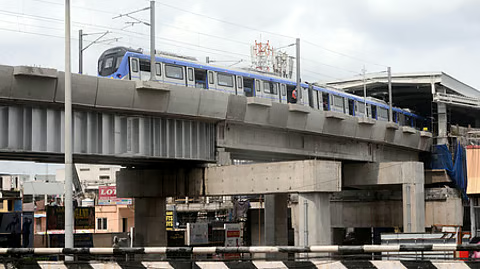
Chennai Metro Operations Stabilise On Airport Line
Chennai’s urban mobility network received a critical boost on Tuesday as metro rail services on the high-traffic Central–Airport corridor were fully restored, easing commuter stress along one of the city’s most economically vital transit spines. The resumption brings operational stability to a route that links the city’s primary rail terminal with its international aviation gateway, carrying thousands of daily passengers, including office commuters, air travellers and service workers.
According to transport officials, regular train frequency has been reinstated following the resolution of a technical disruption that had earlier slowed movement on the corridor. While metro operations across other stretches of the network continued uninterrupted, even minor delays on this particular line tend to ripple across Chennai’s transport ecosystem due to its intermodal importance and peak-hour demand.The Central–Airport corridor plays a pivotal role in reducing dependency on private vehicles along congested arterial roads such as GST Road. Urban planners have long flagged this stretch as a test case for transit-oriented development, with dense residential clusters, commercial hubs, hospitals and logistics centres relying on predictable mass transit access. Any service disruption, experts note, disproportionately affects lower-income workers and time-sensitive travellers who depend on affordable, reliable public transport.
Officials indicated that safety checks and system validations were prioritised before normal services resumed, underlining the growing emphasis on operational resilience within urban rail systems. As metro networks expand in scale and ridership, maintaining reliability becomes as critical as adding new kilometres of track. Industry analysts point out that consistent service performance is essential to sustaining public confidence in metro rail as a viable alternative to road-based transport.
From an environmental standpoint, the return to normal metro operations also reinforces Chennai’s broader climate and mobility goals. Each full-capacity metro train replaces hundreds of private vehicle trips, cutting emissions, fuel consumption and road congestion. Transport economists argue that dependable airport connectivity through electric mass transit is especially important for cities positioning themselves as global business and tourism hubs.The episode has also renewed conversations around preventive maintenance and real-time passenger communication. Commuter groups have repeatedly called for clearer alerts and contingency planning during service interruptions, particularly on corridors with no equivalent rapid transit substitute. Improving last-mile connectivity during such periods remains another area requiring attention, especially for senior citizens and travellers with luggage.
With services stabilised, attention now shifts to strengthening system redundancies and operational transparency as Chennai’s metro network prepares for further expansion. As the city grows outward and travel patterns intensify, the ability of its core transit corridors to absorb shocks will play a defining role in shaping a more inclusive, low-carbon urban future.