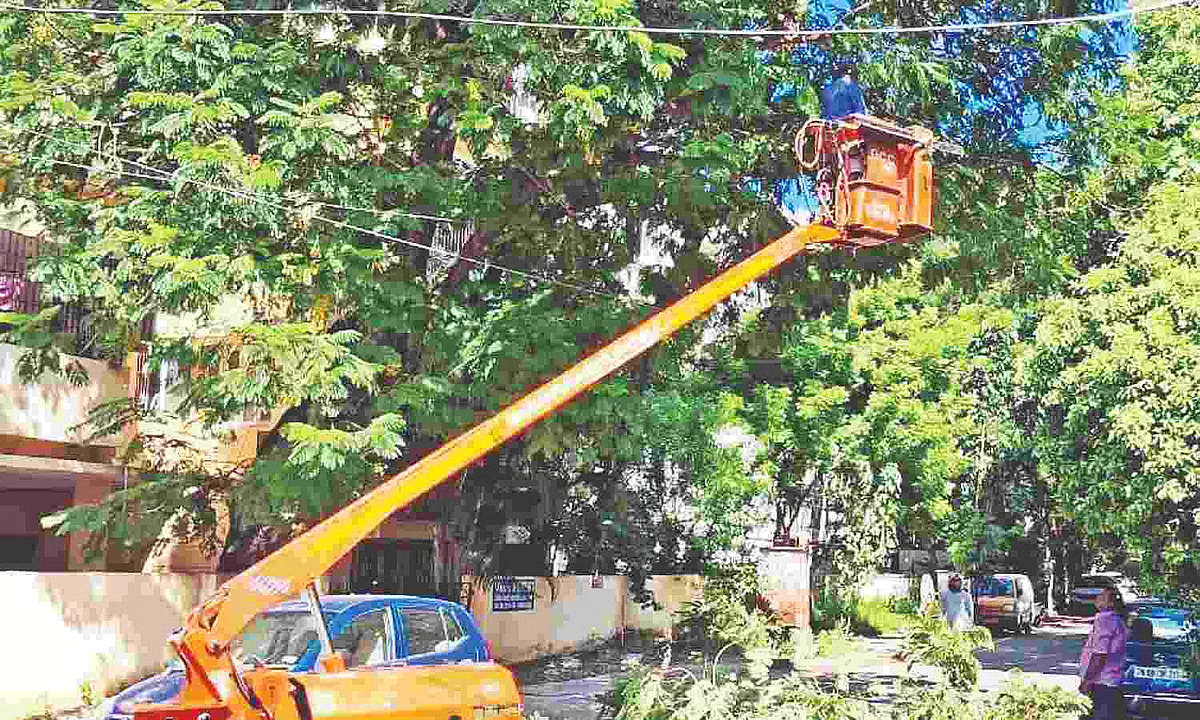
Chennai has moved to significantly tighten safeguards around its shrinking urban green cover, with the city’s civic administration introducing a sharp escalation in penalties for unauthorised tree cutting across public spaces. From mid-January, violations involving tree felling, pruning or removal without approval will attract a fine of up to ₹1 lakh, marking one of the strongest municipal enforcement measures seen in the city in recent years.
The policy shift comes amid growing concern over rising surface temperatures, declining canopy cover and the cumulative ecological cost of rapid infrastructure expansion. Trees in dense urban environments play a critical role in cooling neighbourhoods, absorbing carbon, managing stormwater and improving public health outcomes. For a coastal city already facing climate stress, planners see stronger protection of existing trees as a necessary complement to new plantation drives.
Under the revised system, all requests related to tree management within Greater Chennai Corporation limits must be routed through a centralised digital platform. Both government agencies and private applicants seeking to prune branches, remove hazardous or dead trees, or undertake transplantation are required to apply online through a designated civic portal. The change replaces an older, fragmented approval process and is intended to introduce transparency, time-bound decisions and traceable accountability.
Municipal officials indicate that applications will undergo joint site inspections involving civic staff, forestry personnel and civil society representatives before being evaluated by a statutory committee. Applicants are expected to receive real-time updates digitally, reducing procedural delays that have historically encouraged unauthorised cutting. Lesser but still significant penalties have also been introduced for acts that damage trees indirectly, such as injuring bark, fixing signage or lighting fixtures, or unauthorised lopping of branches.
Urban environmental specialists say the enforcement push reflects a broader rethinking of how cities value natural assets. In many Indian metros, tree loss has often been treated as an unavoidable by-product of road widening, utility upgrades or public construction. The absence of consistent replanting and post-project monitoring has compounded the impact, leaving neighbourhoods more vulnerable to heat and flooding.
Residents’ groups have long raised concerns that compensatory plantation norms are unevenly applied, particularly in public sector projects. The new framework, while welcomed, will be closely watched for how uniformly it is enforced across departments and contractors. Experts stress that penalties alone will not reverse canopy loss unless paired with robust audits, survival tracking of replanted trees and integration of green infrastructure into project planning.
From a city-building perspective, the measure signals a shift towards recognising trees as core urban infrastructure rather than discretionary landscape elements. As Chennai expands its transport, housing and public health assets, balancing development with ecological resilience will be essential.
In the months ahead, the effectiveness of the revised rules will depend on consistent enforcement, inter-agency coordination and public awareness. If implemented rigorously, the policy could set a precedent for embedding climate resilience into everyday urban governance rather than treating it as an afterthought.