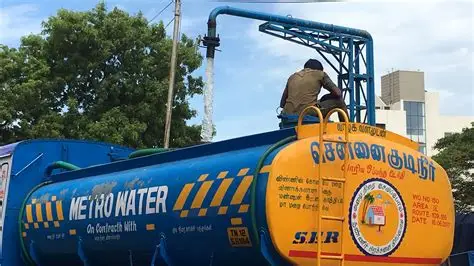
Chennai Expands Tanker Supply Amid Rising Urban Needs
Chennai has significantly increased its reliance on tanker lorries to stabilise urban water access, as the city continues to struggle with uneven piped supply across neighbourhoods. With demand peaking through the dry months, the water utility now deploys roughly 450 contracted lorries making an estimated 3,500–3,900 trips every day across the metropolitan region, reflecting both the scale of the challenge and the dependence on mobile supply systems.
A large share of these trips continues to serve households dependent on street delivery. According to officials, around 1,000–1,300 daily trips currently serve bulk consumers such as apartment complexes, with another 800–900 booked as paid requests. In a bid to reduce waiting time for organised housing clusters, the utility has lifted the cap previously imposed on the number of tanker trips for gated communities, now permitting deliveries upon advance payment rather than on quota. Lorries with larger storage capacity are being routed to suburban pockets that still lack a functioning piped network or where households rely entirely on private suppliers.
Officials argue that these higher-capacity vehicles will cut down the frequency of trips needed for large-volume users, easing operational congestion and shortening delivery cycles. However, the prioritisation of big tankers has also surfaced issues of accessibility for smaller households. Representatives of resident welfare associations acknowledge that the move addresses an immediate urban necessity. A member of a prominent federation said the updated distribution model “benefits both citizens and the utility by improving delivery efficiency”, but added that many residents worry about the long-term sustainability of continuous tanker-based supply for bulk consumers. The sentiment reflects a broader urban concern: tanker water may be a relief, but it does not replace the need for reliable piped infrastructure. Some apartment residents point out that those with limited sump capacity still cannot request 6,000 or 9,000-litre tankers on the booking platforms and are instead compelled to book 12,000-litre vehicles.
For smaller families, this translates into higher costs and wasted surplus. Officials respond that diverting smaller tankers for online deliveries would weaken street supply, especially in lower-income settlements that continue to depend on spot distribution. Urban policy researchers note that Chennai’s present system is a delicate balance — ensuring equitable supply while preventing water markets from drifting into price volatility. Tankers have become an essential cushion for water-stressed neighbourhoods, but overdependence risks normalising a parallel water economy rather than accelerating pipelines and decentralised groundwater recharge. As India’s coastal cities confront unpredictable rainfall and growing populations, urban water policy continues to swing between emergency supply and long-term resilience planning. For Chennai, sustained investment in decentralised systems, wastewater reuse, and universal piped access may determine whether tanker fleets remain a stopgap measure or a permanent fixture of metropolitan life.
Chennai Expands Tanker Supply Amid Rising Urban Needs