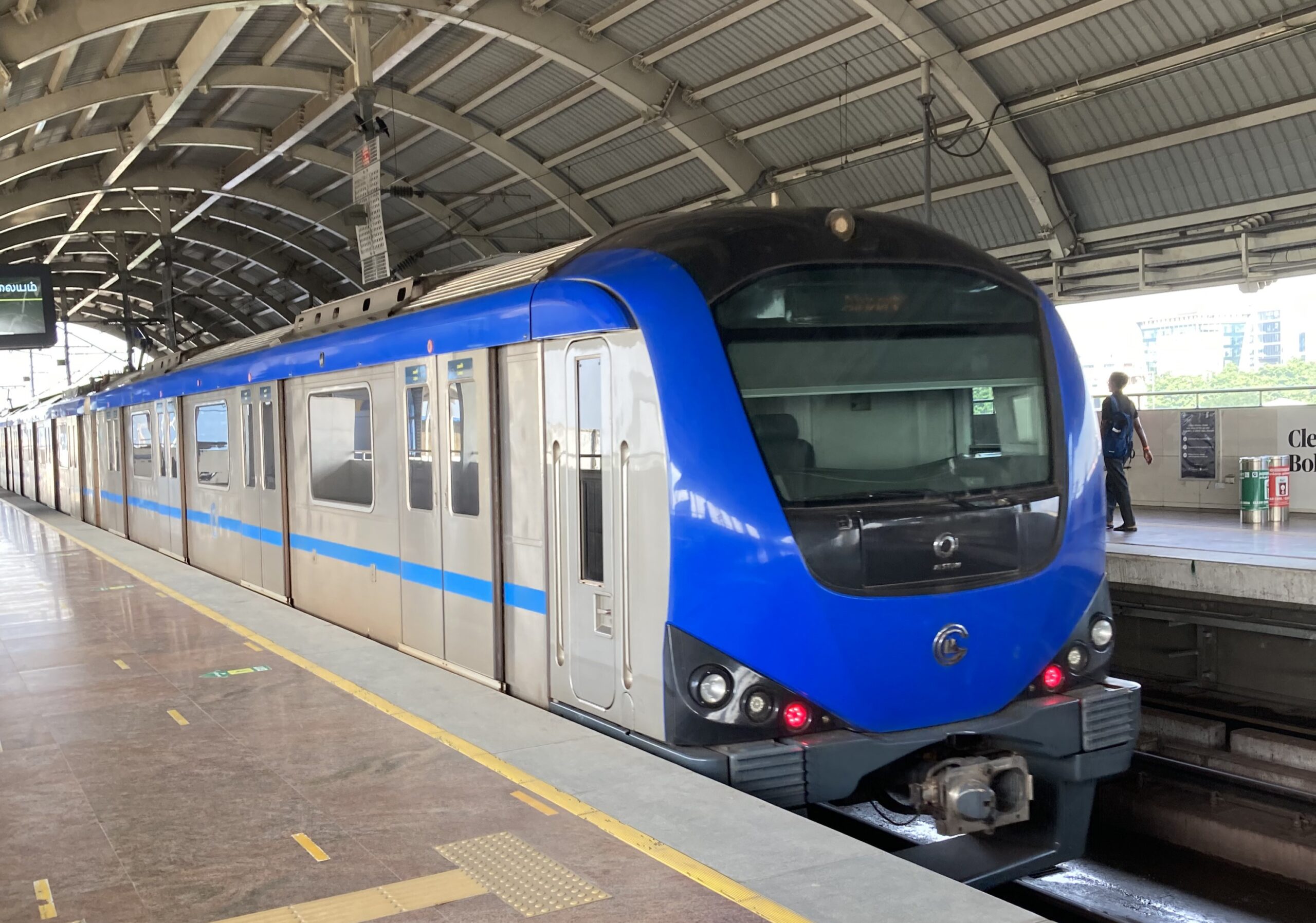
Chennai is quietly redefining the way dense Indian cities can expand mass transit without expanding land use. In a first-of-its-kind rail configuration, the city is nearing completion of a three-level rail corridor that vertically integrates suburban rail, MRTS, and Metro services along a constrained urban stretch, signalling a major shift in how multimodal transport systems can coexist within limited rights-of-way.
The stacked alignment, taking shape in south Chennai, places conventional suburban trains at grade, MRTS services on an elevated deck above, and Metro Phase II trains on a second elevated tier. Urban planners say the project addresses one of Chennai’s most persistent challenges: improving east–west and north–south connectivity without disrupting established neighbourhoods or acquiring additional land. A critical enabler of this configuration is the long-pending MRTS extension linking the city’s beachfront rail hub to St Thomas Mount. The extension introduces new stations across residential and commercial pockets in the southern suburbs, enabling smoother transfers between rail systems that have historically operated in silos. For daily commuters, this integration is expected to reduce transfer times and make public transport a more viable alternative to private vehicles.
The Metro Phase II programme plays a central role in this network. One of its longest corridors runs across the city’s employment clusters, industrial zones, and high-density residential areas, intersecting both suburban rail and MRTS routes. Transport economists note that such intersections tend to deliver the highest ridership returns, particularly in cities where commute distances are growing faster than road capacity. Engineering complexity has been most evident along a short but critical elevated stretch where two rail systems overlap within a narrow corridor. With active tracks below and limited construction windows, engineers adopted unconventional building techniques, including on-site casting and customised lifting equipment. Temporary service suspensions were limited to overnight hours to avoid commuter disruption, reflecting the operational tightrope urban infrastructure projects must walk in live cities.
Beyond mobility, the project carries broader implications for climate resilience and real estate development. Integrated rail systems typically lower per-capita transport emissions and reduce pressure on arterial roads, while improved accessibility often reshapes land values around interchange stations. Urban development experts caution, however, that benefits will depend on pedestrian access, feeder services, and station-area planning.
As Chennai prepares for rising travel demand over the next two decades, the three-level corridor offers a template for future-proofing transport infrastructure in space-constrained metros. The real test will come once operations begin when seamless transfers, reliable service, and inclusive access determine whether this vertical experiment delivers horizontal benefits for the city.