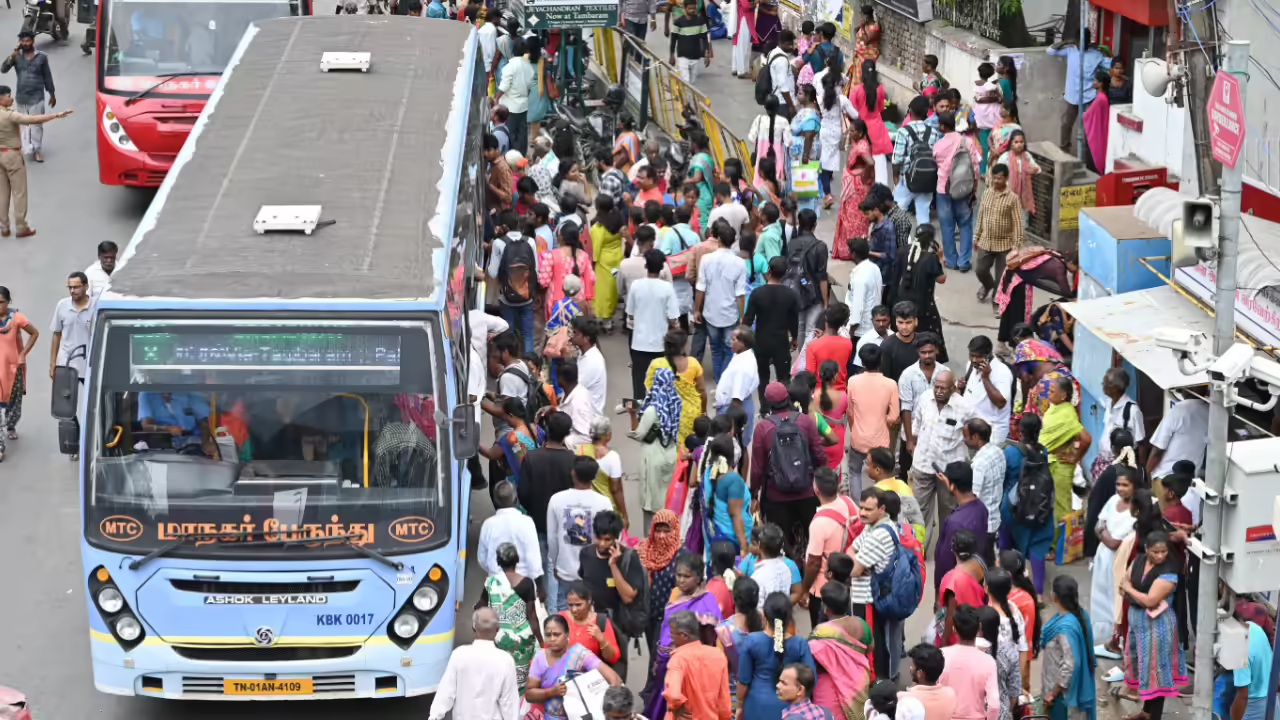
Chennai Commuters Seek Expanded Special Bus Services
Chennai’s suburban transit network is under scrutiny as temporary bus services introduced to offset suburban train disruptions are drawing calls for route expansion and additional halts along major commercial corridors. The Southern Railway recently deployed 20 special buses running 40 trips daily between Tambaram and Chennai Beach, aiming to alleviate congestion caused by curtailed EMU operations. However, commuters highlight gaps in coverage and frequency, particularly along Anna Salai, a key employment and business artery.
The temporary service currently covers GST Road nodes such as Tambaram Sanatorium, Chromepet, Pallavaram, Tirusulam, and Guindy before stopping at central city points, including Ezhilagam, Secretariat, and Parrys Corner. While this has provided some immediate relief for suburban passengers, reliance on the service exposes inefficiencies in scheduling and accessibility. Commuters report inconsistent intervals, with buses meant to run every seven minutes sometimes delayed up to 20 minutes, compelling many to board whichever vehicle arrives first. Urban planners note that temporary measures like these often fail to address the underlying structural gap in Chennai’s suburban mobility network. “Short-term interventions are necessary in crisis situations, but sustainable solutions require integrating bus, metro, and rail services with commuter patterns along dense commercial corridors,” explained a senior transport official. The lack of halts at high-traffic nodes such as Anna University and Kodambakkam restricts access for office workers and students, pushing many to incur additional travel costs or switch to the Metro system.
The issue underscores broader challenges in Chennai’s urban transit planning. Anna Salai alone hosts a concentration of corporate offices, retail centres, and service industries, meaning that limited surface transport options can exacerbate economic inefficiencies. Experts emphasise that inclusive mobility where bus services align with commuter demand supports equitable economic participation and reduces reliance on private vehicles, a key factor in reducing urban carbon emissions. Financially, the additional expenditure incurred by commuters switching from EMU passes to temporary bus passes or Metro rides illustrates the hidden economic costs of partial service disruptions. For businesses, delayed or unpredictable employee commutes translate to reduced productivity, highlighting the interdependence of transit reliability and urban economic resilience.
City authorities have indicated a willingness to review service patterns, with potential adjustments including added stoppages along Anna Salai and tighter scheduling controls. Analysts suggest that any future plan should consider a multimodal approach, integrating buses, Metro, and suburban rail with real-time tracking and flexible routing to improve operational efficiency and commuter satisfaction. Chennai’s temporary transit interventions highlight the need for adaptive, commuter-centric planning that balances immediate relief with long-term sustainability, equitable access, and climate-conscious urban mobility.