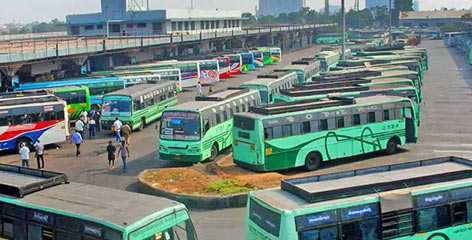
Chennai’s urban transport network is set for a substantial upgrade as the city authority announces plans to modernise nine major bus termini across the metropolis. The initiative, valued at ₹110 crore, aims to enhance commuter amenities, address ageing infrastructure, and integrate commercial facilities to improve operational sustainability.
The project forms part of a phased approach to urban mobility infrastructure. Earlier efforts focused on Madhavaram and Manali, where basic facilities and passenger conveniences were upgraded. The next stage will cover bus termini in George Town, Kathivakkam, Thoraipakkam, Pallikaranai, Ramapuram, Sriram Nagar, Nanganallur, Adambakkam, and Madipakkam. Execution is planned under public-private partnership (PPP) and engineering-procurement-construction (EPC) models, designed to reduce fiscal pressure on the city while promoting faster project delivery and long-term maintenance efficiency. Urban planners note that Chennai’s suburban bus network handles thousands of daily commuters, yet many terminals remain constrained by outdated designs, poor amenities, and limited revenue-generation potential. By incorporating commercial spaces alongside improved passenger facilities, city authorities hope to create financially viable transport hubs that can sustain ongoing operations without depending solely on public funding.
Experts highlight that such upgrades also carry broader socio-economic and environmental implications. Well-designed terminals can improve pedestrian safety, reduce vehicular congestion in surrounding areas, and encourage public transport usage key strategies for achieving climate-resilient, low-carbon urban mobility. Additionally, modern facilities with accessible design features will support inclusive transport, benefiting women, elderly commuters, and persons with disabilities. From a real estate perspective, integrating commercial activity into transit infrastructure can stimulate local micro-economies. Retail, dining, and service outlets within terminals can generate steady revenue, creating employment opportunities and enhancing the value of surrounding properties. Analysts caution, however, that successful integration depends on careful planning to avoid over-commercialisation that might compromise commuter comfort or accessibility.
Implementation challenges remain, particularly given Chennai’s dense urban fabric and ongoing traffic pressures. Authorities will need to coordinate construction schedules with minimal disruption to daily operations while adhering to sustainability benchmarks such as energy-efficient lighting, rainwater harvesting, and waste management systems. If executed as planned, the redevelopment of these nine bus termini could serve as a model for other Indian cities balancing the twin goals of transport modernisation and climate-conscious urban growth. Commuters can expect more efficient, comfortable, and safe travel experiences, while the city gains a network of self-sustaining, multi-functional transport hubs.