


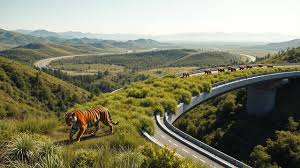
A dedicated wildlife overpass is being integrated into the under-construction Chennai–Bengaluru Expressway, marking a significant shift in how India’s highway expansion intersects with ecologically sensitive landscapes. The structure, planned within the Mahimandalam Reserve Forest between Vellore and Ranipet, is designed to allow free movement of animals across the high-speed corridor without disrupting traffic flow.
The 258-kilometre Chennai–Bengaluru Expressway, currently in advanced stages of development, is expected to become fully operational by mid-2026. While the project is positioned to cut travel time and improve freight efficiency between two major economic hubs, it also passes through forested terrain that supports species such as elephant, gaur, deer, wild boar and large carnivores. Infrastructure planners say the wildlife crossing is intended to reduce habitat fragmentation and roadkill incidents in this stretch.According to officials overseeing the project, the overpass will span roughly 90 metres in length and 25 metres in width, elevated more than five metres above the carriageway. Unlike conventional concrete flyovers, the structure will be layered with soil and native vegetation to simulate natural ground conditions. A grassland cover is planned in consultation with the state forest department to encourage animal usage and ensure the crossing blends into the surrounding ecosystem.
Environmental economists note that wildlife mitigation measures are increasingly becoming a cost component in major transport infrastructure. However, such investments can prevent long-term ecological damage and potential legal delays. In biodiversity-rich regions, habitat disruption often leads to human-animal conflict, crop loss and safety risks for motorists. Integrating ecological design at the planning stage, they argue, is more efficient than retrofitting solutions after conflicts emerge.The Chennai–Bengaluru Expressway wildlife overpass also reflects evolving regulatory expectations. Recent highway projects across India have incorporated underpasses, canopy bridges and fencing systems to safeguard migratory routes. Experts in climate-resilient infrastructure say these measures are critical as road density increases in peri-urban and forest-edge districts experiencing rapid industrial and logistics growth.
For Tamil Nadu and adjoining states, the expressway is expected to stimulate real estate, warehousing and manufacturing investments along its alignment. Urban planners caution that growth corridors must embed ecological safeguards if they are to remain sustainable. Forest patches near expanding townships often act as carbon sinks, groundwater recharge zones and climate buffers.The National Highways Authority has indicated that the Karnataka portion of the corridor is largely complete, while remaining stretches in Andhra Pradesh and Tamil Nadu are nearing completion. As India accelerates expressway construction to strengthen economic connectivity, the Chennai–Bengaluru Expressway wildlife overpass could become a reference model for balancing mobility with conservation.
Whether such crossings succeed will depend not only on engineering precision but also on long-term monitoring and habitat management. For fast-urbanising regions, the challenge is clear: infrastructure must move people and goods efficiently without permanently severing the ecological systems that sustain them.
Also Read:Brigade Expands Commercial Portfolio in Kerala with Twin Projects
Chennai Bengaluru Expressway Adds Wildlife Overpass
