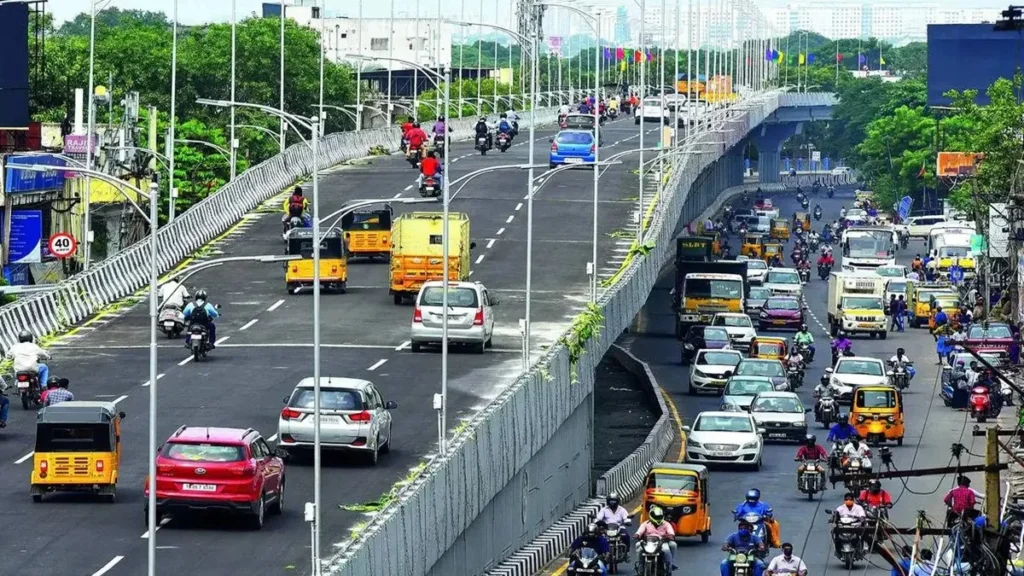
Chennai Announces 3km Flyover to Decongest Guindy–Velachery Traffic Stretch
To ease traffic bottlenecks between Guindy and Velachery, Tamil Nadu has greenlit a new flyover along the 3km Velachery Main Road. Expected to benefit over 7 lakh daily commuters, the four-lane elevated corridor was announced in the 2025–26 state budget. Tenders worth ₹231 crore have been floated, with the project now slated for completion by 2027—provided land acquisition and permissions progress without delay.
The Chennai Corporation has floated tenders valued at ₹231 crore, reflecting a downward revision from the original estimate of ₹310 crore. Officials attribute the cost optimisation to value engineering and revised design efficiencies. The flyover is expected to be 12 metres wide, accommodating two lanes of traffic in each direction. A T-shaped structural layout has been finalised, with approximately 1,100 square metres of land requiring acquisition before construction can begin. Engineers anticipate a construction timeline of two years once the site is cleared and tenders are finalised. If land acquisition and permissions proceed smoothly, the flyover could be operational by 2027, offering considerable relief to commuters currently caught in persistent congestion, especially during peak hours near the 100 Feet Road and Phoenix Mall area.
Urban planners see the move as a timely intervention for a corridor that has seen exponential vehicular growth. Mobility experts, however, caution that infrastructure expansion must go hand-in-hand with multimodal integration, pedestrian prioritisation, and last-mile connectivity for long-term impact. Authorities maintain that the project reflects the state’s ongoing commitment to upgrading Chennai’s transit infrastructure under its smart urban growth model. If executed on schedule, the flyover will significantly enhance east-west road connectivity, bolster commuter efficiency, and reduce travel time while aligning with the city’s broader sustainable mobility goals.
As Chennai grapples with rising traffic volumes and urban sprawl, the proposed flyover offers a much-needed relief valve for strained road infrastructure. However, its success will ultimately depend on how well it is integrated into a larger, people-centric mobility framework. If complemented by inclusive planning and timely execution, the project could serve as a benchmark for future urban transport solutions. Ensuring accessibility, safety, and environmental resilience will be critical for transforming this corridor into a model of sustainable urban development.