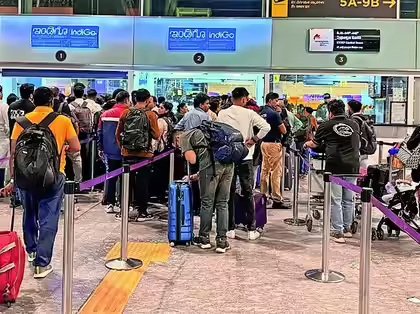
Chennai Airport Faces Widespread Flight Disruptions
Travellers at Chennai International Airport are experiencing significant disruption as flights to key West Asian destinations remain suspended, following escalating military tensions in the region. The cancellations have left hundreds of passengers stranded, creating both logistical challenges and economic ripple effects for the city’s air travel ecosystem.
Airlines operating to Gulf hubs, including Dubai and Abu Dhabi, have suspended services as airspace closures over parts of Iran, Israel, and Iraq restrict operations. Industry analysts note that Chennai serves as a critical node for South India’s outbound international traffic, particularly to the Middle East, making the disruption especially impactful for business travellers, migrant workers, and tourists. A senior aviation official highlighted that stranded passengers are now seeking alternative routes through European carriers, often resulting in extended layovers and higher travel costs. “Dubai functions as a central transit hub for flights to Europe and beyond. Any prolonged suspension there inevitably affects onward connections and cargo movement,” the official added.
Experts emphasise that the disruptions underscore the vulnerability of international air travel to geopolitical instability and the importance of building resilient transport networks. For Chennai, a city increasingly positioning itself as a regional business and cultural centre, such interruptions highlight the need for flexible air service planning, robust contingency arrangements, and passenger support mechanisms. Urban planners and transport economists point out that extended flight cancellations can ripple through local urban economies. Hotels near the airport, ground transportation services, and supporting logistics providers face immediate losses, while delayed business trips and tourism arrivals create longer-term economic uncertainty. In a city that is actively investing in climate-conscious infrastructure and sustainable mobility, maintaining operational resilience at transport nodes has become a critical component of broader urban planning.
From an operational perspective, airlines and airport authorities are coordinating with travellers to manage rescheduling and rerouting. Passengers are advised to monitor official communications and registered contact channels for real-time flight updates. Meanwhile, city authorities are considering measures to support stranded travellers and ensure minimal disruption to domestic connectivity. As global tensions continue to influence air travel, Chennai’s experience highlights the intersection of geopolitics, urban mobility, and economic resilience. Strengthening airport infrastructure, diversifying route options, and integrating contingency planning into urban transport frameworks will be crucial to minimise future disruptions and protect both citizen mobility and the local economy.