


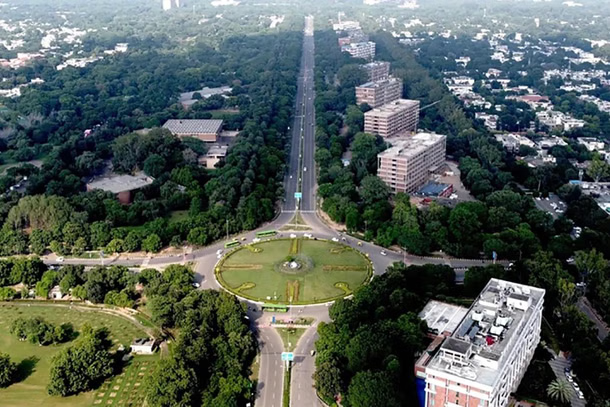
The Union Budget 2026 has triggered a cautious but broadly positive response from real estate stakeholders across the Chandigarh region, with developers welcoming the government’s sustained emphasis on infrastructure investment while flagging the continued absence of housing-specific policy support. For a region shaped by planned urbanism and rising commuter inflows, the Budget’s priorities carry significant implications for future growth patterns.
Public capital expenditure has been raised to Rs 12.2 lakh crore, reinforcing an infrastructure-first strategy centred on highways, metro rail, logistics corridors and urban services. In the Chandigarh–Panchkula–Mohali tricity, developers and urban planners say this focus could strengthen regional connectivity, particularly for satellite towns that increasingly absorb population and employment spillover from the Union Territory. Industry experts note that improved transport networks and regional mobility are critical for the tricity, where residential demand is closely linked to cross-border commuting between Punjab, Haryana and Chandigarh. Better infrastructure, they argue, can reduce congestion pressure on the city’s core sectors while enabling more balanced growth across peripheral urban nodes. However, the Budget’s limited attention to housing affordability has emerged as a key concern. Developers point out that rising construction costs, higher land acquisition expenses and stricter compliance norms have steadily reduced the feasibility of affordable and mid-income housing projects. Without revisions to cost thresholds, unit size norms or targeted fiscal incentives, the share of accessible housing is expected to shrink further in the region.
Urban economists warn that this imbalance could have long-term social and environmental consequences. As affordable supply tightens, households are pushed farther from employment centres, increasing travel distances and carbon emissions while placing additional strain on regional road networks. For a city originally designed around compact planning and green buffers, unchecked sprawl risks undermining Chandigarh’s climate-resilient legacy. The Budget’s broader financial reforms, including measures to de-risk infrastructure investment and expand institutional capital participation, have been viewed positively. Analysts believe these tools could support large-scale commercial, logistics and mixed-use developments in and around the tricity, potentially strengthening employment generation and municipal revenues. At the same time, planners stress that infrastructure expansion must be synchronised with social infrastructure including housing, public transport, water systems and energy efficiency to ensure people-first urban growth. Chandigarh’s experience as a planned city, they argue, offers lessons for integrating density, mobility and liveability, provided policy alignment keeps pace with market forces.
Looking ahead, stakeholders say the real test of Budget 2026 will lie in its on-ground execution. While infrastructure investment can unlock new corridors and economic opportunity, the absence of housing-focused interventions leaves a critical gap. For the Chandigarh region, bridging this divide will be essential to sustaining inclusive, low-carbon urban growth as the tricity continues to expand beyond its original blueprint.
Also Read: West Bengal Developers Back Infra Push Flag Housing Gap
Chandigarh Region Weighs Budget Infra Gains
