


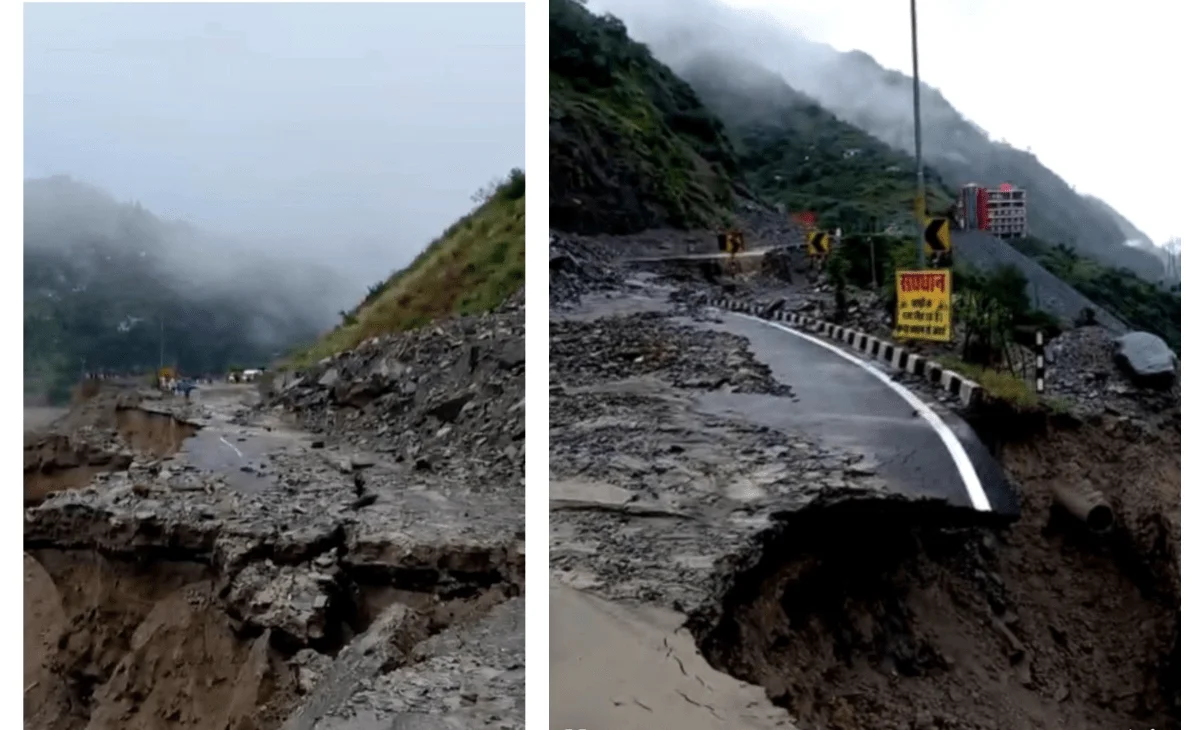
Himachal Pradesh’s relentless monsoon has once again crippled one of North India’s most crucial lifelines, with the Chandigarh-Manali Highway closed following a massive landslide at Banala in Mandi district. The disruption has left hundreds of vehicles stranded, cut off cargo supplies, and highlighted the fragile state of mountain infrastructure amid intensifying climate events.
Authorities confirmed that a portion of the highway was washed away by the swelling Beas River, which has been flowing in spate due to continuous downpour. The highway stretch between Pandoh and Aut has been completely closed for three consecutive days, with repair teams struggling to restore connectivity under persistent rainfall. The closure has not only halted passenger movement but also created serious economic repercussions. Trucks carrying perishable goods, including vegetables and other essentials, remain stuck on the route, with traders reporting spoilage and mounting losses. Several transporters have complained of inadequate arrangements for food and shelter, exposing gaps in disaster preparedness along key national corridors.
Officials on the ground said evacuation efforts are underway in vulnerable areas of Kullu district as water levels continue to rise. Residents and travellers have been urged to avoid unnecessary movement, with district authorities maintaining round-the-clock monitoring of rivers and vulnerable road stretches. The Indian Meteorological Department has issued a series of alerts, warning of more heavy rainfall over the coming days. A red alert is in effect for Chamba, Kangra, and Mandi, while orange alerts have been extended to Shimla, Solan, and parts of Kullu for the weekend. Officials fear that prolonged rainfall could trigger fresh landslides and riverbank breaches, complicating ongoing restoration efforts.
Beyond immediate disruptions, the incident underscores the mounting challenge of balancing infrastructure expansion with ecological resilience in fragile Himalayan terrain. Experts have long cautioned that unchecked construction, riverbank mining, and road widening have destabilised natural slopes, increasing the frequency and intensity of landslides. With climate change amplifying rainfall variability, such episodes are likely to recur with greater severity. For now, stranded commuters rely on occasional community support, with local eateries and volunteers providing meals to drivers stuck for days. The state’s highway division has deployed heavy machinery to clear debris, but progress remains slow given the scale of damage and continuing rainfall.
While the administration focuses on immediate relief, the incident is also a reminder of the urgent need to rethink transport resilience in Himachal Pradesh. For a state heavily reliant on tourism and horticulture, safeguarding critical corridors like the Chandigarh-Manali Highway is not just a logistical necessity but a matter of livelihood and survival for its people.
Also Read: Bengaluru Airport Achieves Indias First Level-2 Accessibility Enhancement Accreditation This Year
