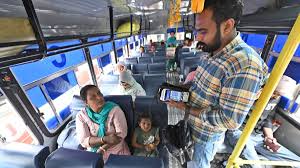
Chandigarh Free Bus Travel Scheme Crosses ₹2000 Crore
Chandigarh- Punjab’s free bus travel scheme for women has now resulted in more than ₹2,000 crore in public expenditure since its introduction, underscoring the growing fiscal scale of mobility-focused welfare policies in the state while also highlighting their role in improving everyday access to jobs, education and healthcare.
State officials recently confirmed that spending on the programme has reached approximately ₹2,042 crore, reflecting several years of reimbursements paid to public transport operators for journeys undertaken by women passengers across government-run buses. Introduced in 2021, the free bus travel scheme allows women residents to travel without paying fares on state-operated buses, a measure designed to reduce mobility costs and increase economic participation. The policy has become one of the largest gender-focused transport initiatives in northern India, with millions of trips recorded annually and a significant share of riders coming from lower-income households.
Urban mobility researchers note that removing daily travel expenses can have a direct impact on workforce participation and educational access. In many towns and peri-urban areas of Punjab, buses remain the most affordable and widely available public transport option, making fare subsidies particularly influential for women who rely on them for commuting. Transport department estimates indicate that several lakh women use the system each day, a surge that has gradually changed ridership patterns on state bus networks. Increased female passenger numbers have also helped stabilise demand for public transport services in smaller cities and rural routes where private mobility options are limited.
However, the expanding fiscal footprint of the programme has also drawn attention to the financial sustainability of transport operations. State-run bus services receive reimbursements from the government to offset the cost of free rides, and transport officials have in the past highlighted the importance of timely payments to maintain fleet operations and service levels. Policy analysts say such schemes illustrate a broader shift in urban governance across India, where mobility is increasingly treated as a social infrastructure rather than a purely commercial service. When designed effectively, subsidised transport can support gender-inclusive urban development by making city economies more accessible to women, particularly those working in informal sectors.
The government is simultaneously exploring complementary social measures tied to mobility and employment. Plans are underway to develop working women’s hostels with childcare facilities in key cities, an initiative aimed at supporting women migrating for jobs and education while strengthening urban safety and accessibility. Urban planners suggest that the long-term success of the free bus travel scheme will depend on parallel investments in bus fleets, digital ticketing, and service frequency to handle rising demand. Integrating technology for passenger tracking and reimbursement systems is also expected to improve financial transparency and operational planning.
As Indian states increasingly experiment with fare subsidies to encourage inclusive public transport use, Punjab’s experience may offer an early template for how mobility policy can shape labour participation, urban access and social equity—provided funding models keep pace with demand.