Chandigarh Administration Expands Local Grievance Redressal System
Chandigarh’s administration has launched a new public grievance engagement initiative aimed at resolving neighbourhood-level civic concerns more directly, beginning with a large citizen outreach camp that handled dozens of complaints across the city’s peripheral colonies.
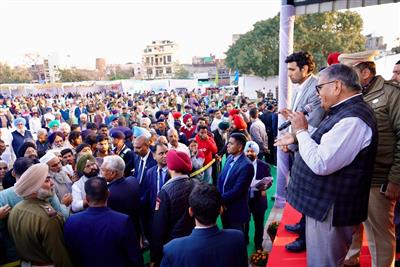
The first session of the initiative, organised in Daddumajra, received 76 citizen grievances covering issues ranging from sanitation and water supply to housing, road infrastructure and social welfare services. Officials present at the event processed complaints and provided immediate updates on several cases, while others requiring departmental action were recorded for time-bound follow-up.
The outreach programme reflects a broader shift toward decentralised urban governance in the Union Territory, where authorities are seeking to bridge the gap between residents and administrative departments by bringing government services closer to communities. By holding grievance camps directly in residential areas, particularly in lower-income settlements and older colonies, administrators hope to address long-standing civic challenges that often struggle to reach formal decision-making channels. During the camp, residents highlighted a wide range of concerns affecting daily life, including sanitation services, drinking water supply, electricity connections, road maintenance, street lighting and public safety. Social services such as healthcare access, education support and welfare schemes were also raised as areas requiring improved coordination between departments.
Urban governance specialists note that such citizen engagement forums can play an important role in improving accountability within city administrations. When multiple departments participate in a single platform, officials can respond more quickly to interlinked issues such as waste management, drainage, lighting and road repairs—problems that often fall across overlapping jurisdictional responsibilities. Alongside the physical grievance camp, authorities also introduced a new digital platform designed to streamline the city’s complaint management system. The online portal allows residents to file grievances, receive a unique tracking number and monitor progress through a structured digital workflow.
The platform is intended to reduce the need for repeated visits to government offices and to ensure that complaints are monitored with defined timelines for resolution. Officials say the system integrates multiple departments within a single digital framework, enabling faster coordination and improving transparency in how civic complaints are processed. Urban planners view the combination of in-person grievance camps and digital platforms as part of a broader transformation in municipal governance across Indian cities. As urban populations expand, administrations are increasingly adopting hybrid systems that combine physical engagement with technology-enabled service delivery.
Authorities have indicated that similar grievance camps will be organised regularly across different neighbourhoods, particularly in colonies where residents may face barriers in accessing government services through traditional channels. Such initiatives can help city administrations identify systemic issues affecting infrastructure and public services, while also building trust between residents and local authorities. For rapidly urbanising regions like Chandigarh, responsive governance mechanisms are becoming an essential component of sustainable and inclusive urban management.
If implemented consistently, neighbourhood-level grievance platforms could provide valuable data for future urban planning decisions, helping authorities prioritise investments in civic infrastructure, environmental services and community facilities where they are needed most.