


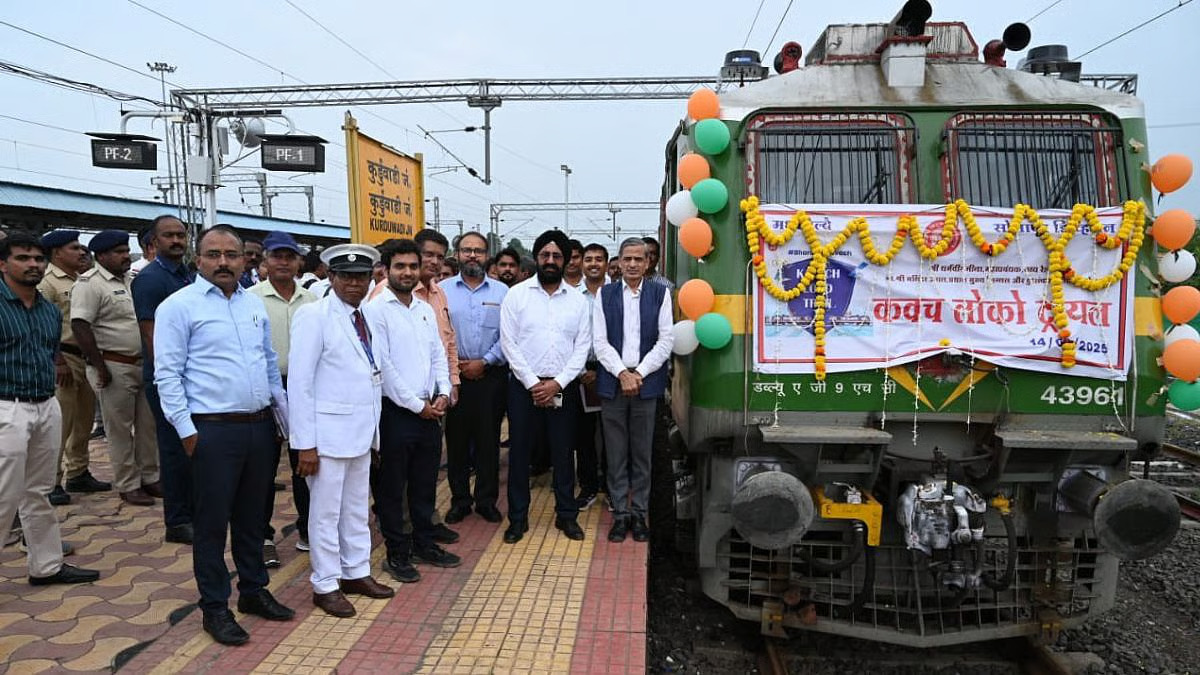
Central Railway has completed trial runs of KAVACH, India’s indigenous automatic train protection system, along the Panvel–Roha section, marking a significant milestone in the push for safer and more sustainable railway operations. Officials confirmed that the system was tested at key stations in the corridor, including Somatne, Apta and Jite.
KAVACH is designed to minimise human error by preventing trains from overspeeding, passing signals at danger, or colliding. The technology functions through real-time data exchange, using radio communication to relay signalling information and train location details. This information is processed to enforce speed restrictions and safe movement limits, ensuring trains operate within secure thresholds. The system, once fully deployed, will act as a digital shield, complementing India’s efforts to modernise its railway infrastructure while prioritising passenger safety. Central Railway has already approved installation of KAVACH on 730 locomotives, and tenders have been floated to extend the provision across its 4,000-route kilometre network covering the Mumbai, Pune, Bhusawal, Nagpur and Solapur divisions.
Officials highlighted that pilot installations of stationary KAVACH systems have been completed at priority stations across these divisions. Extensive testing, alongside network monitoring and staff training programmes, have also been undertaken to prepare for full-scale implementation. The trials in the Panvel–Roha corridor follow earlier demonstrations in the Solapur division, which began earlier this month. Experts describe the introduction of KAVACH as transformative for India’s railways, not only in enhancing passenger security but also in optimising energy-efficient operations. By reducing overspeeding and ensuring smoother control of train movements, the system helps cut unnecessary braking and accelerations, thereby lowering fuel consumption and emissions. This aligns closely with the national agenda of building a low-carbon transport network and achieving sustainable mobility in high-density corridors like Mumbai.
The emphasis on safety comes at a crucial time when Indian Railways is under growing pressure to expand services while maintaining high operational standards. The Panvel–Roha corridor, a vital freight and passenger link, will be among the first to benefit from the full integration of the system. With testing completed successfully, Central Railway now looks to accelerate the phased rollout of KAVACH across its divisions. Officials noted that the system is designed to integrate seamlessly with future expansions, ensuring scalability as train frequencies and passenger demand rise.
As India strives for modern, equitable, and environmentally sound transport solutions, initiatives like KAVACH are set to redefine railway travel, prioritising human safety while supporting the transition towards greener, smarter cities.
Also Read: Delhi NCR And Mumbai Lead As CPCB Reports Rising Ozone Pollution Levels
