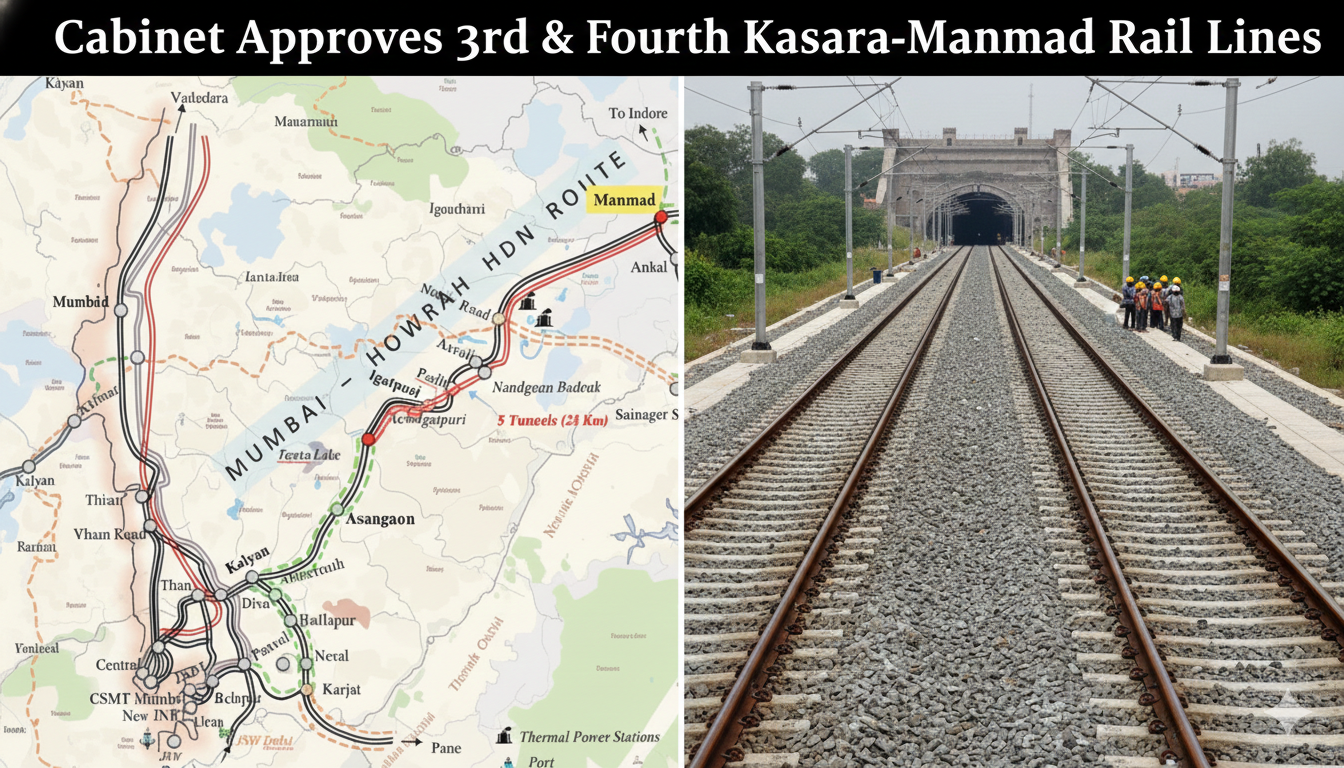
A major rail infrastructure expansion aimed at easing congestion on one of India’s busiest transport corridors has received formal clearance, with the Union Cabinet approving additional railway lines between Kasara and Manmad in Maharashtra. The decision addresses a long-standing capacity constraint on the Mumbai–Howrah route, a backbone for passenger mobility and freight movement across multiple regions.
The approved project involves the construction of third and fourth railway lines across a 131-kilometre stretch spanning Thane and Nashik districts. Transport planners say the expansion is critical for separating suburban, long-distance and freight traffic, a challenge that has intensified with rising commuter volumes and industrial demand linked to western ports and inland markets. At present, the Kasara–Igatpuri ghat section represents one of the most operationally complex segments on the corridor. Steep gradients require the use of additional locomotives to assist trains, increasing travel time and limiting the number of services that can be operated daily. Senior railway officials indicate that the additional tracks will allow smoother operations, reduce delays caused by locomotive changes and release capacity for new passenger services.
Beyond operational efficiency, the project is expected to deliver strategic economic gains. Freight planners estimate a substantial increase in annual cargo movement, strengthening supply chains connecting ports, manufacturing clusters and power stations. This is particularly significant as logistics costs remain a key competitiveness issue for Indian industry. The scale of construction highlights the project’s complexity. It includes multiple tunnels through the ghat terrain, extensive bridge works and grade-separated road crossings. Infrastructure experts note that such investments not only improve reliability but also enhance safety by reducing congestion-related risks in difficult terrain.
From an urban and environmental perspective, the rail expansion aligns with broader goals of shifting long-distance freight and passenger travel away from road-based transport. Railways produce significantly lower emissions per tonne-kilometre, and officials project measurable carbon savings once the corridor is fully operational. The construction phase itself is expected to generate large-scale employment, supporting regional economies during execution. Urban mobility analysts caution that timely delivery will be crucial. Large rail projects in dense and environmentally sensitive regions demand careful coordination, land management and community engagement to avoid delays. If completed as planned, the upgraded Kasara–Manmad section could remove a persistent bottleneck on the Mumbai–Howrah axis, improving punctuality not only in Maharashtra but across connected states.
For India’s largest metropolitan region, the project signals a shift towards capacity-led rail planning—one that recognises railways as central to climate-resilient growth, equitable mobility and long-term economic integration.
Cabinet Approves 3rd Fourth Kasara Manmad Rail Lines