


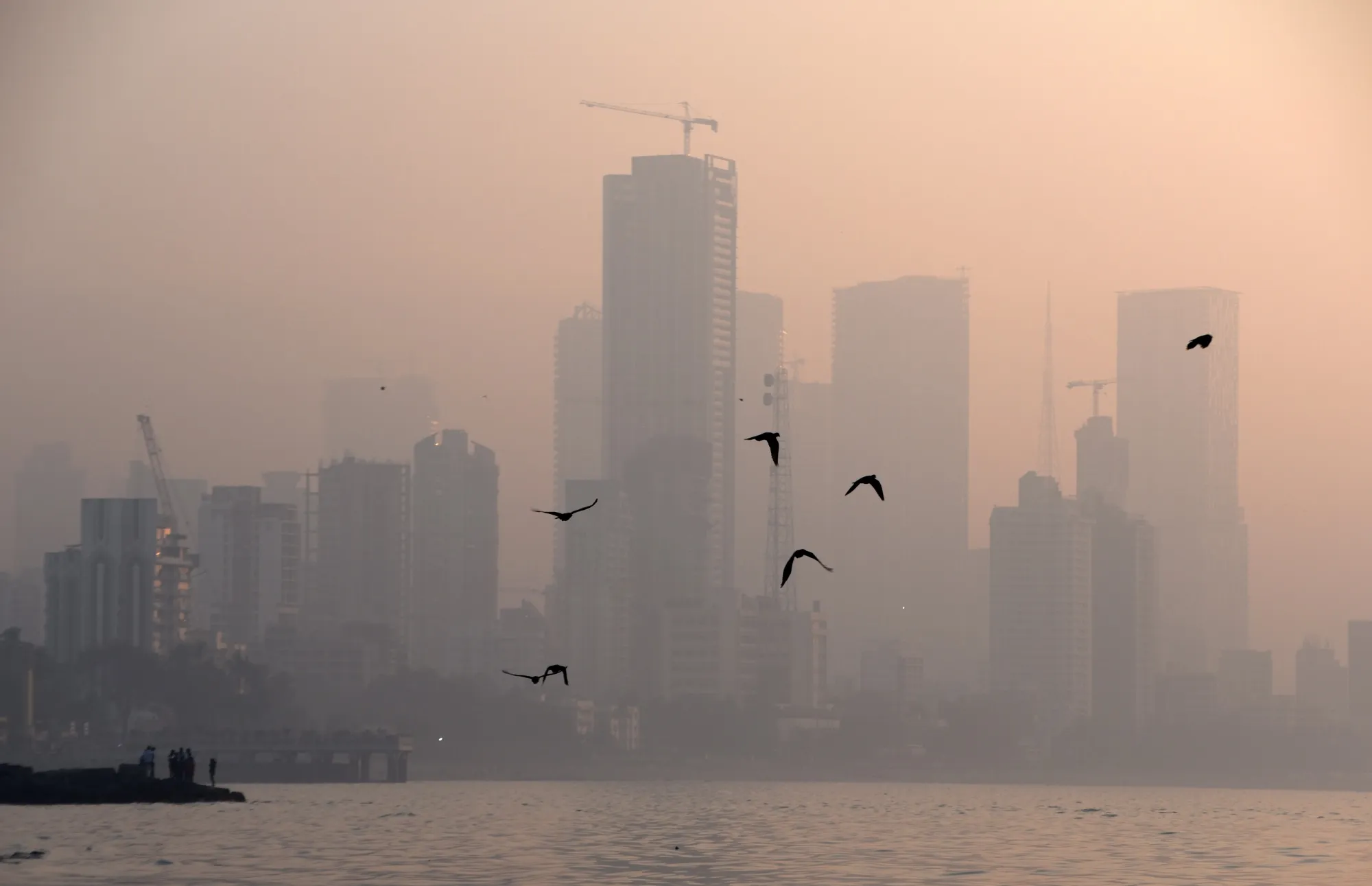
Mumbai began Tuesday under bright skies and a cool morning breeze, but the city’s air quality slipped sharply into the ‘poor’ range, signalling a return of winter smog that continues to blur the skyline and threaten public health. Data from AQI.in placed Mumbai’s overall Air Quality Index (AQI) at 190 — a “poor” level — after several days of moderate readings.
Visibility remained low across major corridors from Bandra-Kurla Complex to South Mumbai as a thin layer of haze lingered despite clear skies. Meteorologists attributed the condition to temperature inversion, which traps pollutants close to the ground during early morning hours. The India Meteorological Department (IMD) forecasted daytime temperatures around 33°C and a minimum of 19°C, marking the season’s first distinct chill. While the drop in temperature brought a winter-like feel, it also slowed the vertical dispersion of pollutants, intensifying local smog. “Cooler air tends to hold pollutants near the surface, especially when wind speeds are low,” said a senior meteorologist, explaining the dip in air quality.
Last week’s brief rainfall had temporarily cleared the city’s air, washing away accumulated particulate matter. But the relief was short-lived. Within days, pollutant levels rebounded as emissions from traffic, construction, and waste burning filled the air once again. The city’s high vehicle density and constant building activity have remained major contributors to particulate pollution, experts noted. Among the monitoring stations, Chembur reported the highest AQI at 257, falling under the “unhealthy” category. Bandra-Kurla Complex followed with 237, while Vile Parle West (233), Kurla (223), and Chakala (210) also recorded elevated levels. Western suburbs performed marginally better — Kandivali East registered 95 (“moderate”), while Malad, Santacruz, and Borivali stayed between 150 and 170 (“poor”).
An environmental consultant observed that while rainfall events offer short-term relief, Mumbai’s pollution patterns are cyclical. “The challenge is structural — emissions rise faster than they are mitigated. Without a sustainable air action plan focusing on clean mobility, construction control, and waste management, winter smog will continue to return,” the expert said. Health professionals have advised citizens to minimise outdoor exercise during mornings and late evenings, when pollutant concentrations peak. Use of masks and indoor air purifiers is also recommended, especially for children and the elderly.
The civic environment department is reportedly monitoring pollution hotspots to strengthen localised mitigation. Urban planners have long emphasised that Mumbai’s fight against air pollution must combine stricter emission norms with green infrastructure — from expanded tree cover to enhanced public transport networks.
Also Read: Maharashtra Mandates 1% Civic Budget Allocation For Pedestrian Safety
Breathing Danger: Mumbai’s Air Quality Takes a Turn for the Worse
