


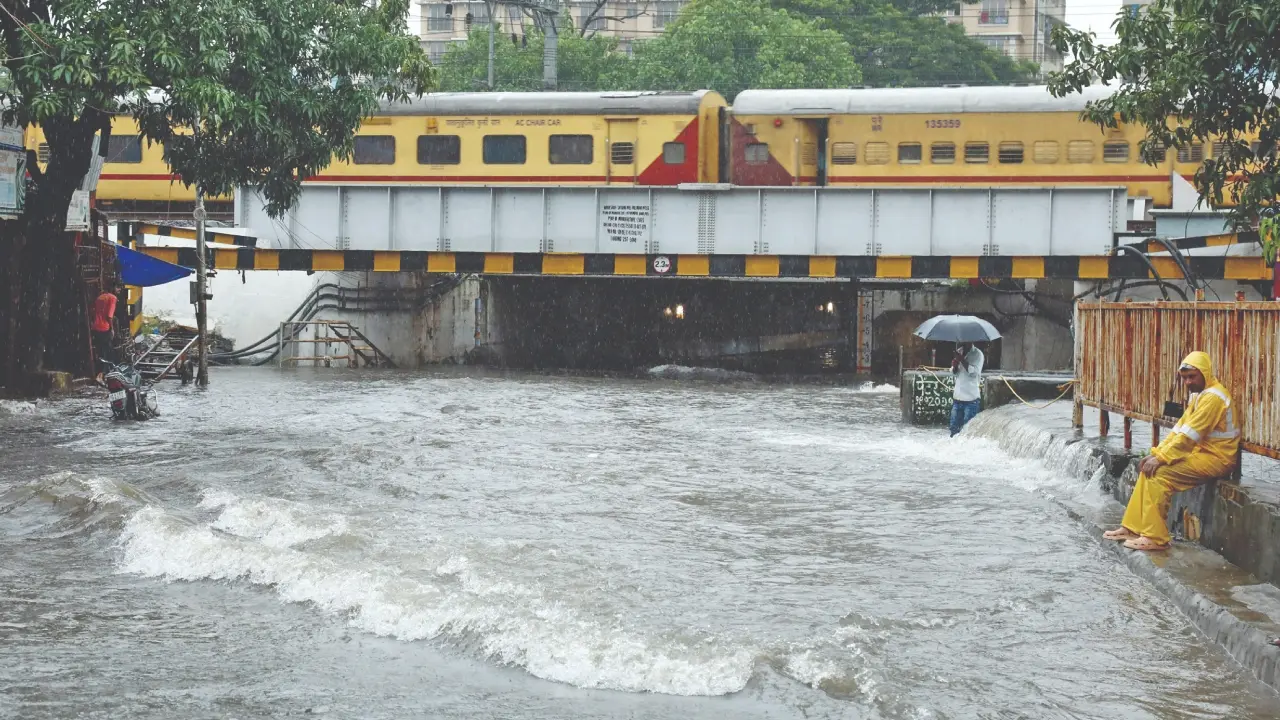
Mumbai’s battle against extreme monsoon flooding has entered a new technological phase as the civic body integrates hyperlocal weather forecasting into its disaster management arsenal. During this week’s intense downpours, officials confirmed that rainfall and flood alerts from a system developed at the Indian Institute of Technology Bombay (IITB) played a critical role in guiding real-time response on the ground.
The portal, accessible at mumbaiflood.in and supported by a companion mobile app, delivers near-real-time rainfall, waterlogging and transport stress updates across the city. The forecasting model, created under the Institute’s Centre for Climate Studies, has been designed to complement bulletins from the India Meteorological Department (IMD) by offering sharper, street-level predictions. Civic authorities said storm water drain teams and local ward offices were able to pre-emptively mobilise equipment and manpower using these hyperlocal forecasts. Experts explained that the portal is capable of generating both three-day rainfall outlooks and short-term 90-minute forecasts. The model analyses cloud reflectivity patterns and precipitation intensity, which are then mapped to specific neighbourhoods. This data is made available not only to the Brihanmumbai Municipal Corporation (BMC) but also to public platforms where citizens can check conditions in their locality. One page of the system tracks stress levels at railway stations, offering valuable inputs for maintaining suburban train operations during torrential spells.
The initiative is the result of a collaboration between IITB’s innovation lab and the civic administration, with support from private sector funding and guidance from the Regional Meteorological Centre in Mumbai. The system has also been integrated into IMD’s Mumbai office for wider meteorological use. Officials noted that advanced algorithms, designed by IITB researchers, have been customised for Mumbai’s topography, drainage and historic rainfall patterns, giving the model sharper predictive accuracy than traditional large-scale systems. To strengthen its early warning network further, the BMC has recently cleared a proposal to partner with Skymet Weather, a private forecaster. The agreement, expected to be formalised through a memorandum of understanding shortly, will bring additional data sources into the civic disaster management framework. Civic officials stressed that diversifying forecast inputs is essential for a city that receives upwards of 2,000 mm of rain each monsoon season and faces frequent flooding in low-lying areas.
With rainfall intensities showing sharp variations across short distances in the metropolis, the push towards hyperlocal forecasting is seen as a step towards building a climate-resilient Mumbai. While challenges remain in drainage infrastructure and citizen preparedness, authorities acknowledge that stronger science-driven forecasting, when paired with responsive civic machinery, can reduce disruption and prevent loss of life during increasingly erratic monsoon events.
Also Read : Mumbai Water Supply Lakes Reach Near Full Capacity After Heavy Monsoon Rain
