


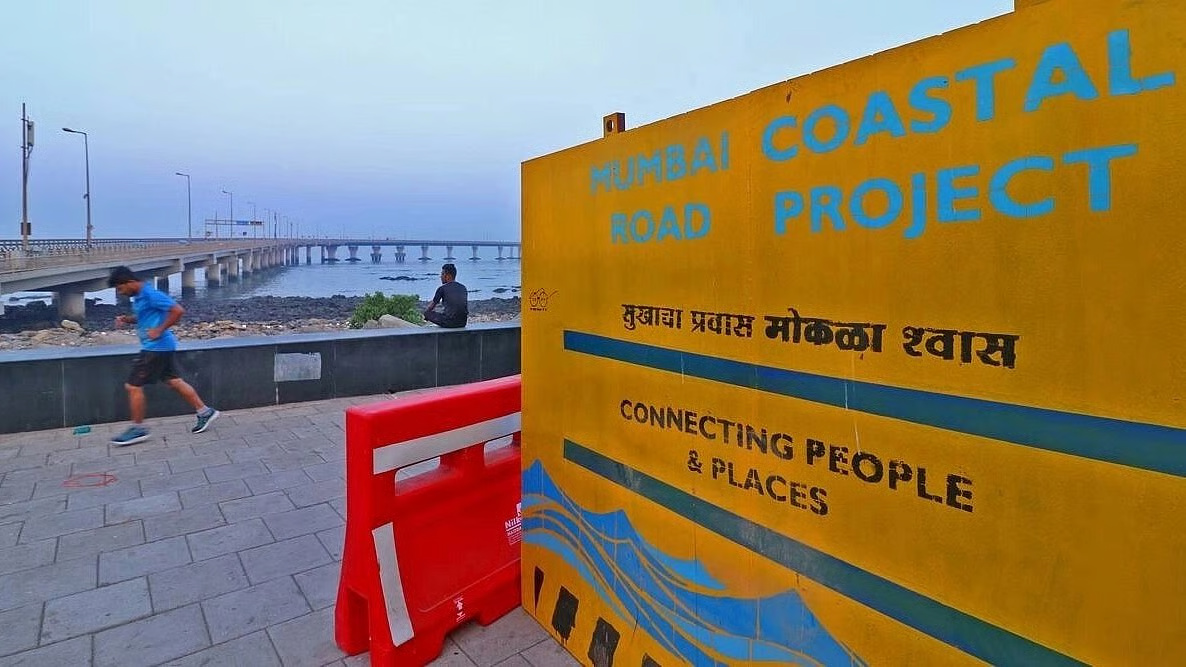
Mumbai’s long-awaited coastal promenade project has moved a step closer to full completion, with the civic administration inviting bids for the final missing link on the seafront walkway. The tender, valued at ₹9.64 crore, aims to construct a 320-metre stretch between Lotus Jetty and Baroda Palace in Worli, with officials indicating that work is expected to conclude before the monsoon season next year. Once complete, the 7.25-kilometre promenade will form a continuous public realm connecting Priyadarshini Park to the Worli end of the Bandra–Worli Sea Link.
The Brihanmumbai Municipal Corporation (BMC) issued the fresh tender after receiving mandatory environmental clearance from the Maharashtra Coastal Zone Management Authority earlier this year. The approval has allowed the municipal body to advance the final segments of the walkway, which is part of a larger effort to create accessible and climate-resilient public spaces along Mumbai’s western coastline. According to a senior civic official, the newly tendered Lotus Jetty–Baroda Palace section will likely see construction begin early next year. The official added that the remaining unopened stretches—totalling 2.25 kilometres—would be taken up sequentially, depending on parallel infrastructure work in the area, including the ongoing underground parking facility at Haji Ali. “We expect steady progress through 2026 as each interdependent segment reaches completion,” the official said.
Two major portions of the promenade, stretching 2.75 kilometres from Priyadarshini Park to Haji Ali and 2.5 kilometres from Baroda Palace to Worli seaface, were opened to the public earlier this year. These spaces have already become popular with walkers, cyclists and residents seeking a safer and more breathable urban waterfront. Once the full alignment opens, planners expect the promenade to more than double the length of Marine Drive, offering a continuous pathway between 8 and 20 metres wide. Urban planners say that such linear public spaces are increasingly vital in dense cities like Mumbai, where access to open areas remains limited and sea-level rise poses a growing threat to neighbourhoods along the Arabian Sea. Experts note that well-designed promenades can serve dual roles—providing recreation space while buffering communities from climate impacts. “These projects are not just beautification efforts; they are elements of long-term coastal resilience,” an urban designer explained.
The promenade forms a key component of the Mumbai Coastal Road Project, a ₹13,984-crore east–west mobility corridor that seeks to enhance connectivity while reclaiming public spaces for non-motorised use. The walkway is being positioned as a people-centric outcome of the larger infrastructure project, embedding sustainability and accessibility into the city’s evolving waterfront. With the tendering process underway and a pre-bid meeting scheduled in late November, the civic body expects a swift start to the final stretch. If timelines are met, the full promenade could be ready by mid-2026, offering Mumbai one of India’s longest and most integrated open waterfronts—an important milestone in shaping a more inclusive and sustainable urban future.
Also Read: BMC Clears Rs 1,635-Crore Kurla–Ghatkopar Flyover Plan To Ease LBS Traffic
