


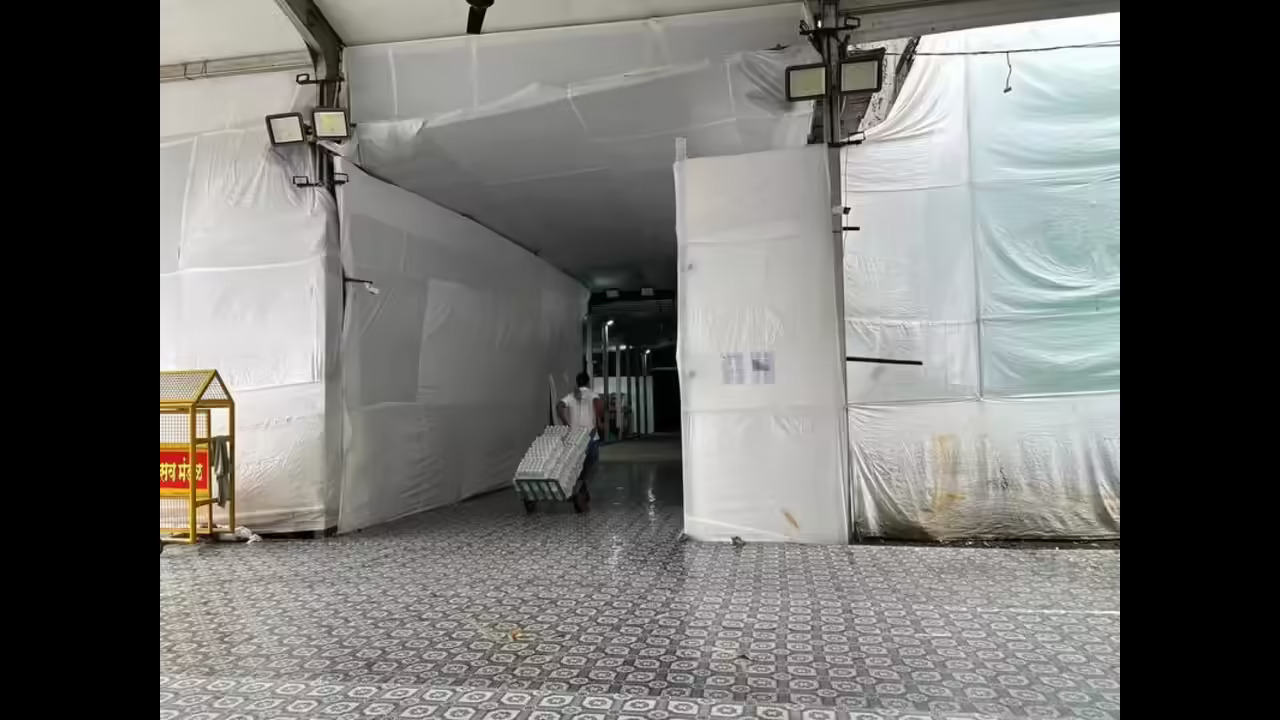
The Brihanmumbai Municipal Corporation has ordered the demolition of unauthorised temporary sheds erected at Peru Compound near Lalbaugcha Raja, citing urgent safety concerns during the peak Ganesh festival season. The civic body has raised alarm that the structures could obstruct movement on narrow roads and pose risks of stampede in one of Mumbai’s most crowded devotional spaces.
According to civic officials, three makeshift sheds—measuring 9 metres, 7.4 metres and 5.3 metres in height—were set up in an open ground near the pandal. Organisers intended to use them for distributing free meals to thousands of devotees expected to visit the revered Ganapati idol. However, the civic body has clarified that no official permissions were presented for the construction, leading to a formal notice being pasted earlier this week. While the notice demanded that the organisers either produce valid approvals or dismantle the sheds within 24 hours, by Thursday evening the structures remained intact and the food distribution had not yet begun. This non-compliance has raised further debate on civic preparedness, crowd management and the responsibility of festival committees in ensuring public safety.
Senior civic engineers privately indicated that the decision was not intended to disrupt devotional activities but to avoid a repeat of past accidents at overcrowded festival sites. “Any obstruction in such narrow lanes has the potential to create unmanageable crowd pressure,” said an official, emphasising that the priority is to safeguard devotees while balancing cultural traditions. The temporary sheds are located within close proximity to the Lalbaugcha Raja mandal, which annually attracts lakhs of devotees from across Maharashtra. With footfalls expected to surge further this year, concerns about unregulated structures have acquired greater urgency. Safety experts argue that while free food distribution is a long-standing cultural practice during Ganesh festivities, it must take place within legally sanctioned and structurally safe spaces.
Urban planners note that the dispute highlights a recurring tension between tradition and urban governance in megacities like Mumbai. On one hand, festival committees are under pressure to meet the expectations of large crowds; on the other, civic bodies are obligated to enforce regulations to prevent accidents. The balance between inclusivity, safety and sustainability has become increasingly delicate. The BMC’s move comes as part of a broader crackdown on unauthorised constructions in high-density areas of the city, particularly during major festivals. Officials have underlined that temporary structures must adhere to fire safety, load-bearing and access norms, given the risk posed by overcrowding. However, as of now, no official statement has been made on whether the civic body will forcibly dismantle the sheds if organisers fail to comply voluntarily.
For now, the controversy underscores how India’s largest city grapples with maintaining cultural vibrancy while adhering to safety, equity and sustainability in urban spaces. Whether the sheds will finally be removed or regularised remains uncertain, but the episode has already reignited conversation around the responsibilities of both civic authorities and festival organisers in safeguarding public life.
Also Read: Mumbai Sion Residents Face 12 Years Delay As Compound Wall Remains Pending
